
Dove's-foot crane's-bill
Geranium columbinum L.
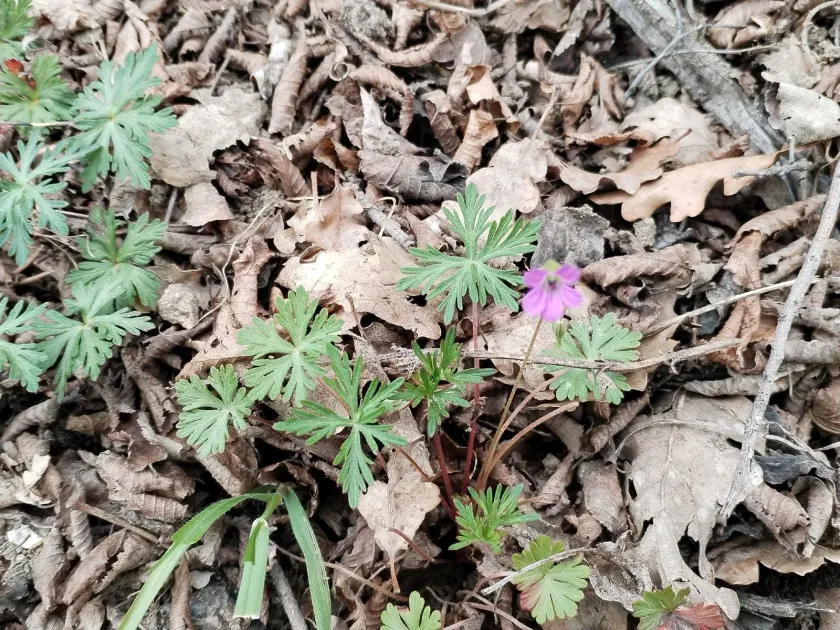
Description
Sowing dates
Geranium columbinum is an annual herbaceous plant whose life cycle in agroecosystems typically begins in the spring. Optimal germination conditions occur when soil temperatures reach 8–10 degrees Celsius, generally corresponding to April or early May.
The plant demonstrates high adaptability, with seeds remaining viable in the soil for several years. Under favorable, moist autumn conditions, winter-type seedlings may emerge, successfully overwintering in a rosette stage and ensuring rapid growth at the start of the following season.
Seed depth during natural dispersal is usually shallow, not exceeding 1 to 3 centimeters. In agricultural settings, it is critical to note that surface soil disturbance often triggers mass germination, making effective seedbed management essential for control.
Seedling emergence intensity is directly correlated with light exposure and topsoil moisture levels. In dense crop stands, Geranium columbinum often suffers from competition due to its significant heliophilic nature, which limits its ability to thrive in shaded environments.
The flowering period is extended, spanning from June through August, which complicates management schedules. Fructification begins approximately 30 to 40 days after flowering, requiring timely intervention to prevent the buildup of the soil seed bank.
Growing requirements
This species prefers light, well-drained, calcareous, or neutral soils. It is frequently encountered in dry meadows, rocky slopes, road verges, and cereal fields where crop competition is minimal and light penetration is high.
The plant is highly sensitive to excessive moisture and waterlogging in the root zone, making heavy clay soils unsuitable for its development. It requires open, sunny locations with high solar radiation levels for optimal vegetative mass development.
From an agronomic perspective, Geranium columbinum acts as an indicator of base-rich soils, though it does not necessitate excessive nitrogen fertilization. Sufficient levels of phosphorus and potassium in the soil solution promote faster generative organ development.
Climate requirements include moderate temperatures, as the plant can withstand short drought periods thanks to its deep taproot system. However, prolonged drought during the flowering phase can significantly reduce seed production capacity.
To effectively manage the spread of the species, incorporating crop rotation with row crops is recommended. Frequent inter-row cultivation allows for the mechanical destruction of young rosettes before they reach the reproductive stage.
Main diseases and pests
The species exhibits high resistance to most common pathogens affecting agricultural crops. However, under conditions of high humidity, the plant may be susceptible to powdery mildew, characterized by a white fungal growth on the foliage.
Among insect pests, various leaf beetles and weevils may feed on the vegetative parts. Nonetheless, these pests generally do not cause significant economic damage to primary crops unless high populations are allowed to persist near field edges.
It is important to acknowledge that Geranium columbinum can serve as an alternative host for certain parasitic fungi that may potentially transition to cash crops. This necessitates rigorous phytosanitary monitoring of field borders adjacent to natural habitats.
Systemic herbicide applications show high efficacy against this weed during early developmental stages. The best results are achieved when treatments are applied at the cotyledon stage or when the first true leaves emerge.
The lack of highly specialized natural enemies within the local entomofauna allows this species to remain a competitive weed in fields with poor agronomic management. A comprehensive control strategy should combine both mechanical and chemical intervention methods.