
Dudleya lanceolata
Dudleya lanceolata
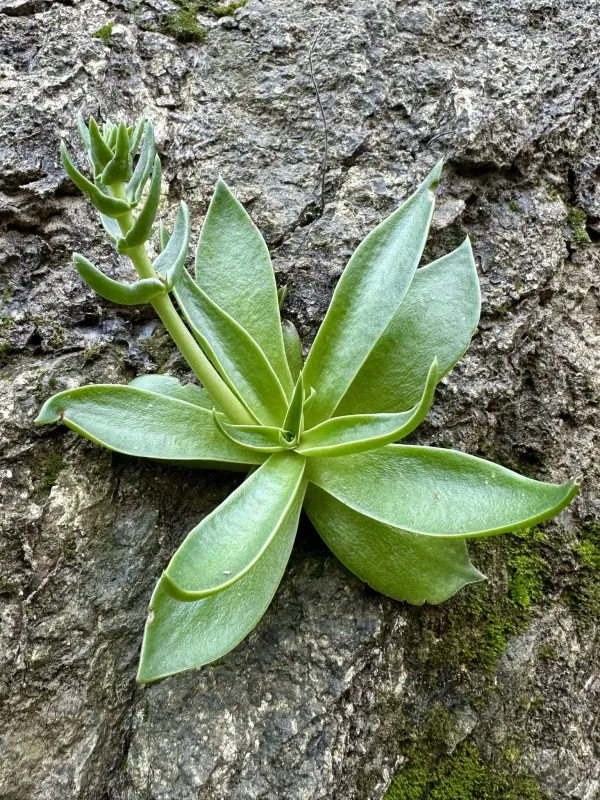
Description
Sowing dates
Propagation of Dudleya lanceolata in cultivation is primarily achieved through seeds or vegetative separation of offsets. Seeds should be sown in late winter or early spring into a well-draining, sandy substrate.
Sowing is performed on the surface, without burying the seeds, as they require light exposure for successful germination. The surface of the substrate is lightly covered with fine gravel to secure the seeds and prevent the root system from drying out too quickly.
Maintaining a stable temperature between 18–22 degrees Celsius is essential for success. Seedlings usually emerge within 3–4 weeks, after which they must be gradually acclimated to open air and reduced humidity levels.
For vegetative propagation, lateral offsets are separated from the parent plant during the active growing season. Before planting in soil, the cut must be air-dried in the shade for several days to prevent rotting.
Rooting of cuttings is conducted in a dry substrate without watering for the first week, allowing the plant to adapt and initiate the formation of new roots.
Growing requirements
Dudleya lanceolata is a member of the Crassulaceae family, native to the rocky regions of California and Mexico. It is a succulent adapted to Mediterranean climates characterized by dry summers and mild, moist winters.
The plant requires bright, direct sunlight to maintain its compact rosette form and vibrant leaf coloration. Insufficient light leads to etiolation, which severely compromises the plant's aesthetic and overall health.
The soil substrate must be highly permeable, consisting of a mixture of coarse sand, perlite, and a small amount of peat. Using heavy clay soils is detrimental to the root system due to the high risk of moisture retention.
During the growing season, watering should be moderate and performed only when the soil ball has completely dried out. In winter, during the period of dormancy, watering should be almost entirely suspended.
Dudleya prefers excellent air circulation, which is particularly important when grown in greenhouses or indoor environments. Excessive humidity combined with low temperatures frequently leads to the development of fungal infections.
Main diseases and pests
The primary threats to this crop are sap-sucking pests such as mealybugs and spider mites. Upon the first signs of infestation, immediate treatment with appropriate insecticides or acaricides is necessary.
Root rot is the most common disease, caused by improper watering habits and the use of an unsuitable substrate. The infection spreads rapidly through the plant tissues, often leading to total loss.
Gray mold can affect the rosettes during periods of high humidity and stagnant cool air. The disease manifests as soft brown spots on the leaves, which require the immediate removal of affected sections.
Aphids occasionally attack the young flower stalks, draining the plant of essential nutrients. Insect population control is managed through systemic insecticides or mechanical removal.
- Regular inspection of rosettes for spider mite webbing.
- Ensuring substrate purity before planting.
- Maintaining constant airflow in the cultivation area.