

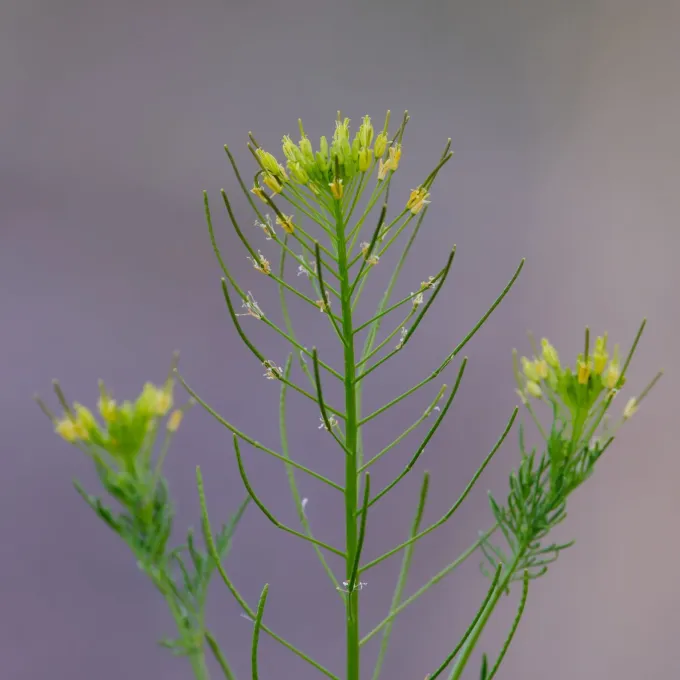
Description
Sowing dates
Flixweed (Descurainia sophia) is an annual herbaceous plant belonging to the Brassicaceae family. Increasingly recognized as a versatile oilseed crop, it thrives in various environments due to its resilience.
Sowing typically takes place in early spring, as soon as soil temperatures reach 4–6 degrees Celsius, allowing the plant to leverage residual winter moisture for rapid early development.
Seeds should be planted at a shallow depth of 1–2 centimeters, as they are very small. Utilizing a standard grain drill at a row spacing that ensures even distribution is recommended for optimal plant density.
The seeding rate varies between 4 and 8 kg per hectare, depending on soil preparation and seed quality. Ensuring proper soil-to-seed contact via rolling is crucial for high germination rates.
The crop grows quickly, forming a rosette that naturally suppresses weed development during the early stages of growth, which significantly reduces the need for chemical herbicide interventions.
Growing requirements
This crop is highly adaptable to various soil types, ranging from sandy to loamy textures. It shows remarkable tolerance to poor soil fertility and even saline conditions, making it suitable for marginal lands.
Flixweed is a sun-loving plant that thrives in temperate climates. It is exceptionally drought-tolerant, which makes it an economically viable option for regions facing water scarcity and climate instability.
The ideal growing temperature ranges from 18 to 25 degrees Celsius. The plant is resistant to mild spring frosts, allowing for early planting cycles without compromising the establishment of the crop.
While fertilization, particularly nitrogen, can boost vegetative growth, excessive application should be avoided to prevent over-luxuriant foliage that may distract energy from seed production.
Flixweed is an excellent candidate for crop rotation. Its root system improves soil structure and aeration, leaving the soil in a better condition for subsequent cereal or legume crops.
Yield
With proper management, yields for Flixweed can reach 1.0 to 2.5 tons per hectare. The seeds contain a high percentage of oil, making them a valuable raw material for the industrial sector.
The yield is highly dependent on effective crop establishment and management during the blooming phase. Optimal conditions during flowering significantly increase the number of seeds per silique.
The potential for high productivity is realized through the selection of high-performing varieties that exhibit better seed retention and uniformity in ripening, which is essential for efficient harvesting.
The economic efficiency of cultivating Flixweed remains high due to low input costs. Seed material is affordable, and the crop's minimal requirement for intensive maintenance ensures profitability.
Ongoing research into advanced agronomic practices aims to further stabilize and increase yield, ensuring that this crop continues to be a viable alternative for commercial farming.
Main diseases and pests
The most significant pests are flea beetles, which can devastate young seedlings. Regular field monitoring is essential during the emergence phase to deploy insecticides promptly if damage thresholds are exceeded.
Other potential threats include pollen beetles and various bugs that damage flowers or pods. Integrated Pest Management (IPM) strategies, including biological and chemical controls, should be employed.
Diseases such as downy mildew and alternaria can occur under high humidity conditions. Maintaining proper spatial isolation between fields and avoiding over-dense stands helps mitigate these risks.
Preventative measures, including high-quality seed treatments and rotation practices, are vital to preventing the accumulation of soil-borne pathogens and ensuring long-term field health.
- Regular field scouting.
- Targeted insecticide use.
- Adherence to rotation cycles.
- Effective weed management.
Harvesting
Harvesting should occur during the wax-ripening stage. It is crucial to monitor the field closely to prevent seed shattering, which can happen if the plants remain in the field for too long.
Grain combines should be configured specifically for small-seeded crops to minimize loss. Adjusting the cylinder speed is essential to prevent seed damage while ensuring thorough threshing.
Post-harvest cleaning is necessary to remove impurities, followed by drying to 12% moisture content to ensure long-term stability and quality of the oil during storage.
The oil derived from Flixweed has numerous industrial applications, including the production of biofuels, lubricants, and high-quality paints or coatings due to its stable fatty acid profile.
The seed cake remaining after oil extraction is rich in proteins and, after appropriate treatment, can be utilized as a supplement in animal feed formulations.
Reference
Connections · Flixweed
Most often together:
Marketplace
Products · 35


Gorstar, WG
«ДжангсуIнстiтьют оф Екомонес Ко., Лтд.», (JiangsuInstituteоfEcomonesCo.,Ltd.)Джангсу, Китай. ф. «Жеджіанг Хісун КемікалКо., Лтд.» (Zhejiang Hisun Chemical Co., Ltd.) Жеджіанг, Китай
Herbicides
0
0
1 offer
1.43 €per pack
Buy


