
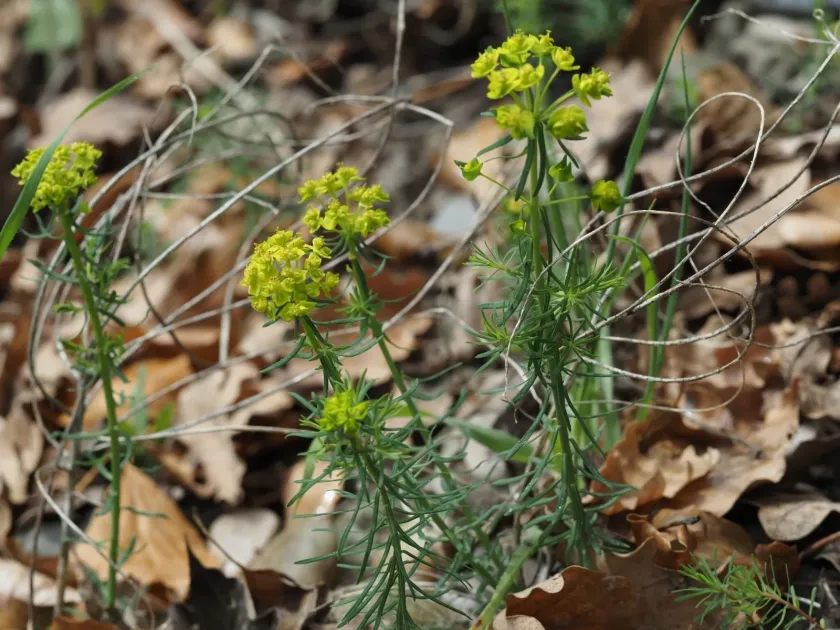
Description
Growing requirements
Cypress spurge (Euphorbia cyparissias L.) is a perennial herbaceous plant belonging to the Euphorbiaceae family. In agricultural settings, it is primarily recognized as a persistent, rhizomatous weed that competes with crops for soil moisture and nutrients.
The plant is distinguished by its narrow, pine-needle-like leaves and yellow-green floral bracts. It develops an extensive lateral root system that allows it to regenerate even after severe mechanical damage, making it difficult to eradicate completely.
It thrives in well-drained, sandy, or rocky soils and is highly drought-tolerant. While it can be found in a variety of habitats, it prefers open fields, pastures, and disturbed ground where it can colonize areas with low plant competition.
The original range of the plant encompasses much of Europe and parts of Western Asia. Due to its hardiness, it has spread throughout North America as an introduced species, becoming a significant challenge in range and pasture management.
Because the plant contains a toxic, milky latex, it is generally avoided by grazing livestock. This lack of herbivory allows Cypress spurge to maintain dominance in infested pastures, further reducing the overall forage quality.
Main diseases and pests
Cypress spurge can serve as an alternative host for various fungal diseases. Specifically, it can harbor rust fungi that are capable of infecting agricultural legumes, posing a hidden risk to nearby bean or pea crops.
Managing this weed requires a multi-faceted approach. Mechanical tillage alone is often ineffective because any remaining root fragments can easily initiate new growth, leading to an even denser infestation.
Chemical control with systemic herbicides is the most common approach. The waxy cuticle on the foliage often necessitates the use of adjuvants to ensure proper uptake of the active ingredient by the plant's vascular system.
Biological control efforts have been attempted using specific insects, such as the flea beetle Aphthona lacertosa. These biological agents have shown success in reducing dense populations of Cypress spurge in non-crop areas.
Effective long-term management relies on a combination of herbicidal applications during the active growth phase and the establishment of vigorous forage grasses that can outcompete the weed for light and space.
Content graph
Connections · Cypress spurge
Most often together:
Marketplace