
Yellow star-thistle
Centaurea solstitialis L.
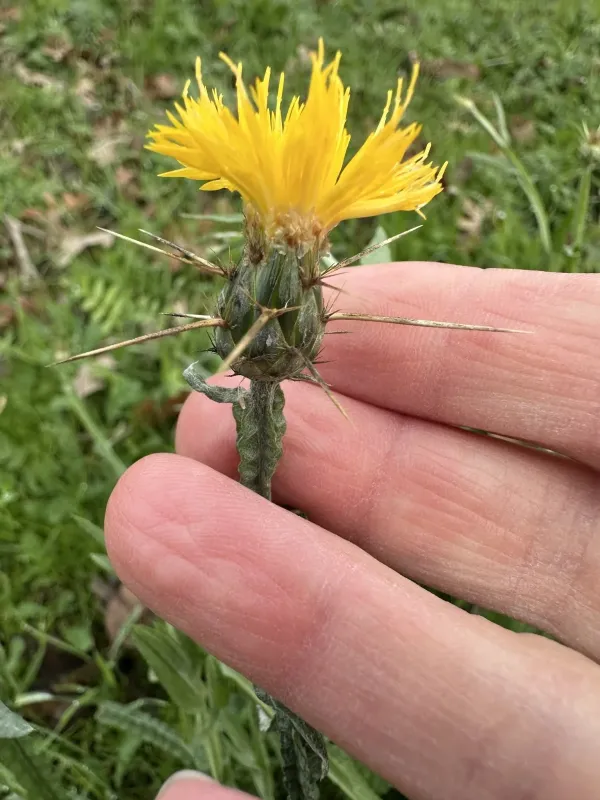
Description
Growing requirements
Yellow star-thistle (Centaurea solstitialis L.) is a winter annual plant belonging to the Asteraceae family. It is recognized globally as a highly invasive and harmful weed in various agricultural sectors.
Originating from the Mediterranean region, it has successfully invaded grasslands and crops across the globe. Its biological success is attributed to its ability to colonize disturbed soils and open fields efficiently.
The plant features a deep taproot and a winged stem with characteristic yellow flowers surrounded by sharp, long spines. These spines protect the plant from grazing animals and make manual harvesting difficult.
It thrives in environments with high solar exposure and well-drained soils. Its ability to tolerate dry conditions allows it to outcompete many native grasses during the peak of summer when water is scarce.
Good agricultural practices include managing soil disturbance and ensuring that farm equipment is cleaned before moving between fields. Establishing healthy crop competition is essential for reducing the risk of infestation.
Main diseases and pests
The most significant danger posed by this plant is its toxicity to horses. Ingestion of the plant causes a condition called nigropallidal encephalomalacia, commonly known as "chewing disease," which can be fatal.
Yellow star-thistle acts as a major competitor for resources in wheat and barley fields. Its extensive root system depletes soil moisture, often leading to reduced crop yields and degraded pasture quality.
Pathogens and fungi that affect the plant are generally not aggressive enough to control it naturally. Research into plant diseases as potential biocontrol agents remains largely in the experimental stage.
Various insect pests, including gall-forming flies and seed-feeding weevils, have been introduced in certain regions to help limit the spread by reducing seed output.
Chemical control remains the most reliable method for management. Herbicides such as clopyralid or glyphosate are typically used in localized treatments, specifically when the plants are in their rosette stage.