
Red star-thistle
Centaurea calcitrapa L.
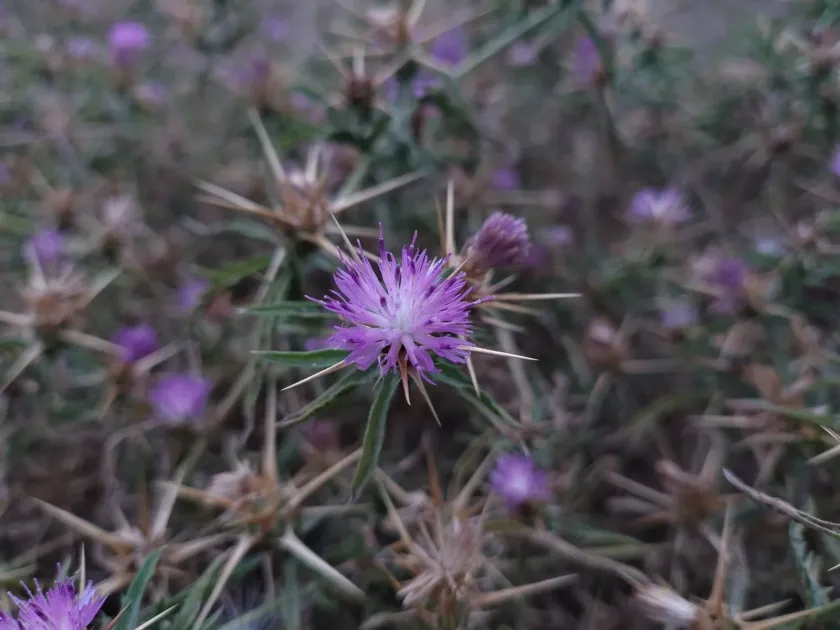
Description
Sowing dates
Red star-thistle is a biennial or annual herbaceous plant of the Asteraceae family. In agricultural settings, it is classified as a significant weed that thrives in disturbed soils, competing intensely with crops for water and mineral nutrients.
Germination typically occurs in late winter or early spring, following periods of moderate rainfall. Seeds can remain viable in the soil seed bank for several years, which makes consistent monitoring necessary throughout the crop rotation cycle.
To control the plant before sowing, producers should utilize mechanical cultivation. Shallow tillage during the early seedling stage is most effective, as the young plants have not yet established deep, woody taproots.
Crop rotation serves as a primary non-chemical method of control. By planting competitive cover crops, farmers can shade out the seedlings of the star-thistle, significantly reducing its density in subsequent cash crops.
Integrity of seed stock is vital. Because the seeds are easily transported by farm equipment and machinery, cleaning equipment thoroughly between fields is an essential step in preventing the spread of this aggressive invader.
Growing requirements
This species is highly adapted to arid and semi-arid climates. It exhibits a strong preference for open, sun-exposed areas and cannot survive under dense crop canopies, making crop competition a key management strategy.
The plant is not picky about soil composition. It is frequently found on dry, rocky, sandy, or poorly maintained soils where other species struggle to establish due to low nutrient availability or extreme moisture stress.
With a deep taproot, red star-thistle extracts water from deeper soil profiles than many common field crops. This ability provides a competitive advantage during dry spells, leading to significant crop yield suppression.
Temperature range for active growth is broad, with the plant showing remarkable vigor during the high-heat periods of summer. This heat tolerance allows it to mature and produce seeds even in conditions that would cause stress to most cultivated vegetables or grains.
Chemical control via selective herbicides is often necessary in heavily infested areas. Treatment must be applied during the rosette stage, as the plant becomes increasingly resistant to chemicals once the spiny, woody stems begin to elongate.
Main diseases and pests
As a host for various insects, red star-thistle poses a threat to nearby crops. Aphids and other pests frequently use the plant as a refuge, moving into adjacent fields once populations grow too high or when the weed begins to dry out.
Fungal pathogens such as rusts and powdery mildew can reside on the leaves of the star-thistle. Although the weed is hardy, these pathogens can easily cross over to more sensitive crops, resulting in significant economic losses.
The physical characteristics of the plant, specifically the sharp spines on the seed heads, cause damage to harvesting equipment and pose a safety risk to agricultural workers during routine field maintenance.
Economic impact includes not only yield loss but also the increased cost of grain cleaning. Contamination of harvested grains with star-thistle seeds can lead to lower market value or rejection of the entire lot.
- Water resource depletion in fields.
- Increased maintenance costs for machinery due to spines.
- Loss of crop marketability through seed contamination.
- Higher expenditures on chemical interventions.