
Calanthe vestita
Calanthe vestita
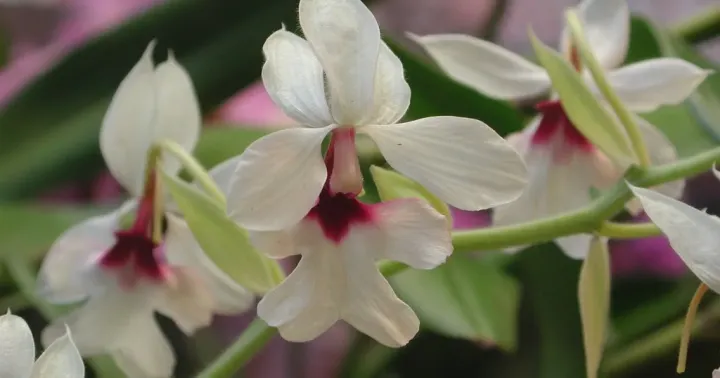
Description
Sowing dates
Propagation of Calanthe vestita in both commercial and domestic settings is most commonly performed via vegetative methods, specifically by dividing large pseudobulbs during the dormancy period.
The optimal time for repotting and division of the plants is early spring, just before the emergence of new growth shoots.
Seed-based propagation is rarely used in commercial culture due to the high difficulty of orchid seed germination and the requirement for sterile laboratory conditions.
Planting is carried out in a loose substrate that ensures excellent drainage, as the roots of Calanthe are highly sensitive to waterlogging.
When using pseudobulbs for propagation, it is crucial to ensure proper depth in the substrate to prevent the rotting of the new shoot growth point.
Growing requirements
Calanthe vestita is a deciduous sympodial orchid belonging to the Orchidaceae family, native to the tropical forests of Southeast Asia.
The plant requires bright, indirect light, avoiding direct sunlight, which can cause significant damage to the delicate foliage.
During the growing season, temperatures should be maintained between 22 and 28 degrees Celsius, while during dormancy, a drop to 15–18 degrees is required.
The soil must be rich in organic matter and highly breathable; a mixture of conifer bark, sphagnum moss, and charcoal is considered ideal.
Special attention must be paid to air humidity; for full development, it is necessary to maintain humidity levels between 60 and 70 percent.
Main diseases and pests
The primary threats to Calanthe are fungal diseases, which arise from improper watering schedules and poor ventilation in the growing area.
The most common pests include spider mites and scale insects, which proliferate rapidly in low-humidity conditions.
Excessive moisture in the substrate often leads to root system rot, which can result in the loss of the entire pseudobulb.
To prevent pest spread, it is recommended to conduct regular leaf inspections, particularly on the undersides, and maintain hygiene in the cultivation zone.
At the first sign of insect infestation, specialized insecticides should be applied, or leaves can be wiped down with a mild soap solution.
Harvesting
Harvesting or cutting the flower spikes of Calanthe vestita is performed for decorative purposes once the majority of buds on the inflorescence have opened.
Flower spikes must be cut with a sharp, disinfected tool to prevent pathogens from infecting the main body of the plant through the cut site.
The economic use of this culture is focused on floriculture and the greenhouse industry, where it is valued as an exotic decorative specimen.
After flowering concludes, the flower spike is removed entirely, as it does not re-bloom and continues to drain nutrients from the plant.
Following the harvest or bloom cycle, the plant enters a dormant phase where watering is minimized as the leaves naturally yellow and shed.