
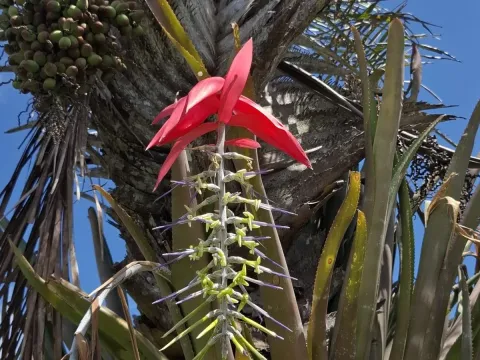
Billbergia
Billbergia Thunb.
Billbergia is a genus within the Bromeliaceae family, native to the tropical forests of Central and South America. These perennial epiphytic or terrestrial plants are highly adapted to the humid and shaded conditions of their native environments.
What the section contains

Billbergia
The plant features a distinctive rosette of stiff, often prickly leaves that serve as a natural reservoir for collecting water and organic debris. In commercial and home cultivation, Billbergia is prized for its long-lasting inflorescences and vivid, pendulous bracts.
Successful cultivation requires a loose, well-draining, acidic substrate that resists compaction. The ideal temperature range for active growth is between 20°C and 25°C, with a cooler period during the winter months often necessary to trigger the development of flower spikes.
Humidity management is critical; Billbergia thrives in environments with relative humidity above 60%. Irrigation is typically applied directly into the leaf rosette, though caution is required to prevent water stagnation in cooler weather, which can lead to rapid decay.
Propagation is predominantly achieved through the division of offsets or "pups." This vegetative method is highly efficient, as the young plants are separated from the parent rosette in the spring once they have developed sufficient root structure to thrive independently.
Mealybugs and scale insects represent the most significant pest threats to Billbergia, as they frequently hide in the tight leaf axils. Infestations weaken the plant, causing distorted growth and the accumulation of honeydew, which may lead to secondary sooty mold infections.
Root and crown rot are common physiological and fungal problems triggered by improper irrigation practices. Excessive soil moisture combined with poor air circulation often results in the rapid deterioration of the plant's base and root system.
Spider mites are a persistent threat in environments with consistently low humidity. These pests feed on the undersides of leaves, causing characteristic stippling, chlorosis, and eventual leaf drop if the ambient humidity is not restored promptly.
Fungal leaf spot diseases can develop if water is allowed to pool in the rosette under insufficient light or ventilation. These infections are best controlled by improving cultural conditions, removing infected debris, and applying targeted fungicide treatments.
Mineral stress, often caused by using hard water or over-fertilization, manifests as leaf tip burn or white residue accumulation. Using distilled or rainwater and applying specialized low-concentration bromeliad fertilizers helps maintain plant health.