
Desert milkweed
Asclepias subulata Decne.
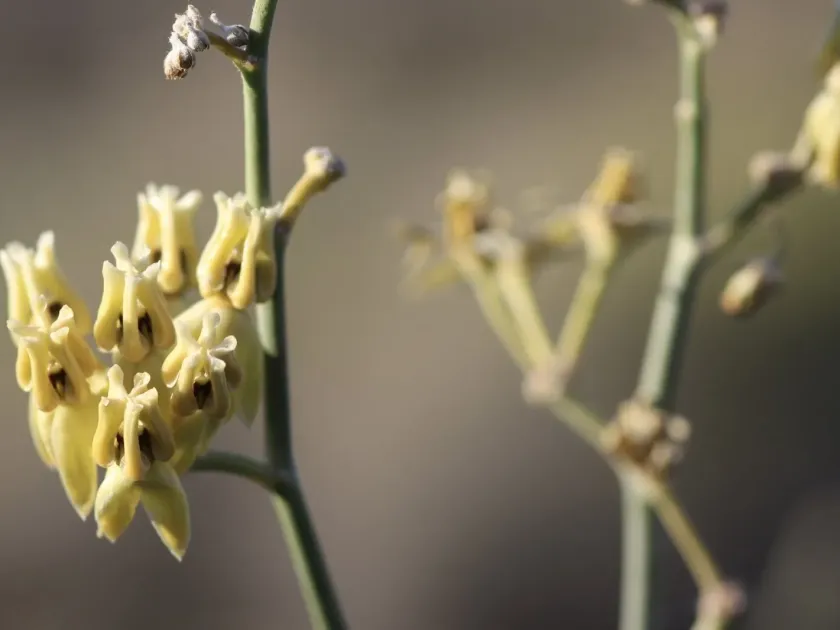
Description
Growing requirements
Desert milkweed (Asclepias subulata) is a perennial shrub belonging to the Apocynaceae family. It is native to the arid regions of southwestern North America, including parts of Mexico and the USA, where it has evolved to thrive under extreme heat and severe water scarcity.
The plant features thin, upright, rush-like stems that can reach heights of 0.5 to 1.5 meters. These stems are photosynthetic, allowing the plant to sustain growth in desert environments where leaf production would be an inefficient loss of water.
It has minimal soil requirements and performs well in well-drained, sandy, or rocky soils with low nutrient content. The crop exhibits remarkable tolerance to saline conditions and high pH levels, making it a viable candidate for agricultural use in marginal lands.
As a true xerophyte, desert milkweed requires full sun exposure and low humidity. Poor drainage is the most significant threat to the plant, as stagnant water in the root zone leads to rapid decay and plant mortality.
The agronomy of desert milkweed centers on establishment. Once the seedlings are successfully rooted, the plant becomes incredibly resilient, requiring virtually no irrigation or supplemental fertilization, which makes it an ideal low-input crop for harsh climates.
Yield
The primary agricultural interest in desert milkweed lies in its latex, which contains organic rubber and resins. Research highlights this species as one of the most promising sources for renewable natural rubber production in regions where traditional rubber trees cannot grow.
Beyond rubber, the plant produces durable fibers that can be utilized in the textile industry or as fillers for composite materials. Its chemical composition also suggests potential uses in the production of bio-polymers and sustainable chemical feedstocks.
Biomass yields are closely tied to planting density and the duration of peak solar radiation. The plant is capable of producing a consistent volume of biomass even in low-rainfall years, ensuring steady supply cycles for industrial extraction processes.
Economic feasibility is driven by the low cost of maintenance. Ongoing agricultural studies focus on mechanizing the harvest of the stems to lower labor costs, aiming to make the extraction of high-quality latex commercially competitive.
The crop is also being investigated for its utility in biofuels and renewable energy production. The hydrocarbon content within the plant tissue makes it a versatile resource for generating secondary energy products in dryland agricultural systems.
Main diseases and pests
Root rot is the most common disease for desert milkweed, primarily triggered by waterlogging or inadequate soil drainage. Prevention relies on careful site selection and the implementation of efficient water management practices to ensure the roots remain oxygenated.
Pests such as aphids and certain true bugs may occasionally infest the plants; however, the presence of toxic glycosides in the milky latex serves as a potent natural defense. Consequently, insect damage is generally minimal compared to conventional food crops.
Weeds pose a threat mainly during the establishment phase. Once the plants reach maturity, their dense root systems and physical structure effectively compete with most weeds, minimizing the need for manual or chemical weed control in established fields.
Environmental stress, particularly sudden drops in temperature combined with high humidity, can compromise plant health and increase susceptibility to fungal pathogens. Regular field monitoring is necessary to maintain a healthy and productive crop population.
Because desert milkweed is highly adaptive, growers must monitor for potential invasiveness. Managed cultivation practices are essential to prevent the spread of the species into non-target natural habitats, ensuring ecological compatibility in the region.