
Flax-leaved milkweed
Asclepias linaria Cav.
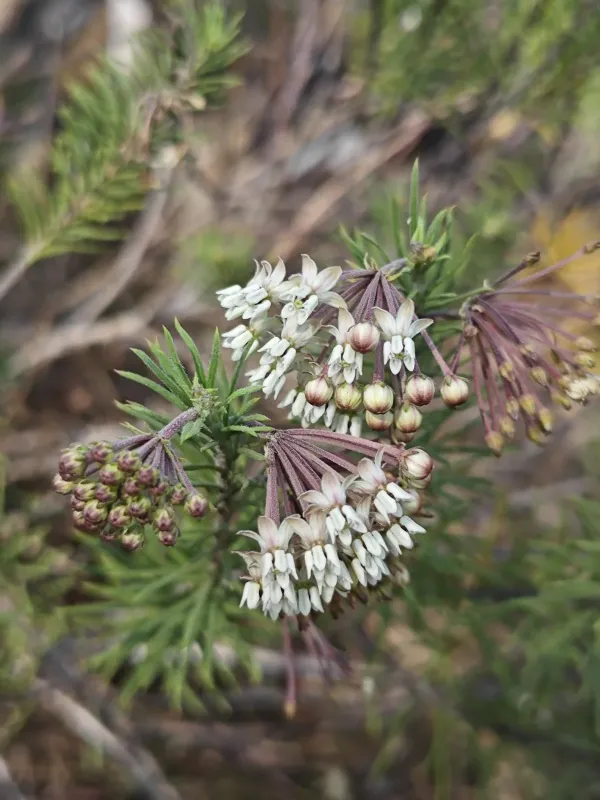
Description
Sowing dates
Flax-leaved milkweed (Asclepias linaria) belongs to the Apocynaceae family. Native to the arid regions of Mexico and the Southwestern United States, it is a resilient perennial shrub well-adapted to harsh environmental conditions.
Sowing schedules depend on local climatic conditions. In temperate regions, seeds should be sown in the spring once soil temperatures reach a consistent +15°C, ensuring optimal germination rates.
Pre-treatment of seeds, specifically cold stratification, is highly recommended to improve germination efficiency. Seeds should be sown shallowly, at a depth of 1-2 centimeters in well-draining soil.
During the early seedling stage, growth is relatively slow, requiring careful weed management. Providing adequate spacing is essential to ensure that plants have sufficient nutrients to establish a deep taproot system.
Initial irrigation is necessary to support seedling establishment. Once the root system is well-developed, the plant becomes highly drought-tolerant, reducing the need for constant moisture.
Growing requirements
This crop thrives in full sun exposure. Maximum solar radiation is critical for both the development of its characteristic linear leaves and the accumulation of latex and fiber within the stems.
Asclepias linaria is well-suited for poor, sandy, or rocky soils. High drainage is the most important soil requirement, as the plant is highly susceptible to root rot caused by waterlogging.
The optimal temperature range for active growth is between +22°C and +30°C. The plant can survive short periods of cold but is not frost-hardy, limiting its large-scale cultivation to warmer regions.
The ideal soil pH is neutral or slightly acidic. Excessive fertilization, particularly nitrogen, should be avoided as it can adversely affect the quality and strength of the plant fibers.
Maintenance requirements are minimal compared to traditional field crops. Regular clearing of competing vegetation and occasional pruning can help maintain plant vigor and optimize fiber yield.
Yield
The primary agricultural interest in Asclepias linaria lies in its bast fiber, which is located in the stems. The total yield of biomass depends significantly on planting density and soil fertility levels.
Beyond fiber, the plant serves as a potential source of natural latex. Research into the industrial extraction of latex from this species highlights its role as a sustainable alternative in various sectors.
Sustainable biomass yield is achievable with consistent field management. Proper harvesting techniques ensure that the annual productivity of the plantation remains stable over several growing cycles.
The quality of harvested material depends heavily on the stage of growth. The highest concentration of quality fibers is typically found during the peak flowering phase of the plant.
Seed production is an important secondary yield. Because the flowers are primarily pollinated by insects, maintaining local pollinator populations is essential for achieving a high volume of quality seeds.
Main diseases and pests
Aphids are the most common pests, often clustering on young shoots. They can cause significant damage by sucking sap, which stunts growth and reduces the overall vigor of the crop.
Fungal diseases, such as powdery mildew, can occur in environments with poor air circulation or excessive humidity. Maintaining proper row spacing is the best preventive measure against these pathogens.
Nematodes pose a threat to the underground parts of the plant, potentially leading to wilting and reduced biomass yield. Regular monitoring of the soil and root health is highly recommended.
While the milky latex provides a chemical defense against many herbivores, some specialized caterpillar species have adapted to feed on the foliage. Crop inspections are necessary to detect these infestations early.
Integrated pest management (IPM) strategies, which prioritize biological control and cultural practices, are preferred to maintain the ecological integrity of the harvest and soil quality.
Harvesting
Harvesting the stems should occur during the full flowering stage, which ensures the fiber is mature and strong. This stage provides the best balance between biomass quantity and fiber quality.
Mechanical harvesting methods are used to cut the stems, leaving a portion of the base intact to ensure the plant can regenerate for the next growing season. Precision in cutting height is critical.
After cutting, the biomass must be dried immediately. Efficient drying processes prevent fermentation and degradation of the natural fibers, preserving their mechanical properties for industrial use.
The decortication process, which separates the fiber from the woody inner stem, requires specialized machinery. Fine-tuning equipment to the specific properties of the stem is necessary to prevent fiber breakage.
Seed harvesting should be synchronized with the opening of the pods. Because the seeds are equipped with wind-dispersing hairs, timely collection is necessary to prevent significant yield losses during the ripening phase.