
Anthurium veitchii
Anthurium veitchii
Description
Growing requirements
Anthurium veitchii, commonly known as the King Anthurium, is an epiphytic perennial plant belonging to the Araceae family. Originating from the rainforests of Colombia, this species thrives in humid, shaded environments where it grows on tree trunks and damp rocks.
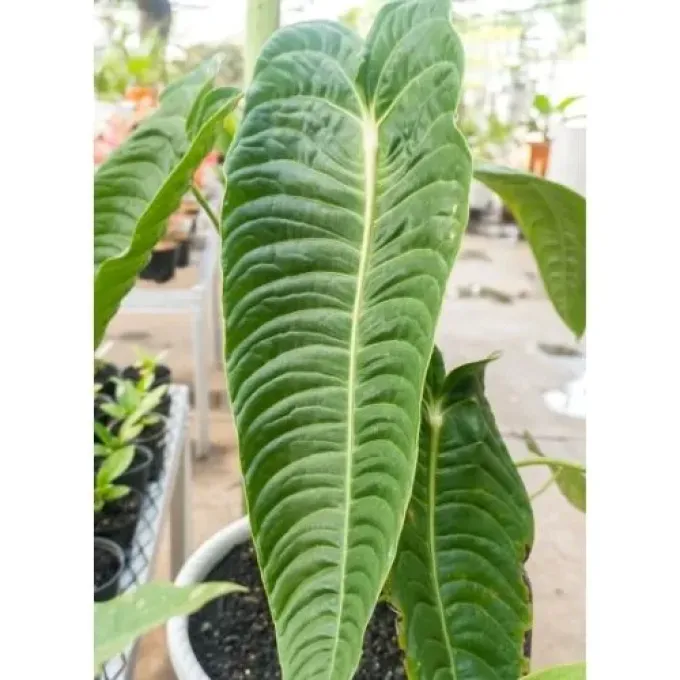
The plant is highly prized for its spectacular foliage, featuring long, pendulous leaves that can reach several feet in length. The leaves are distinguished by a deep, dark green color and a unique, heavily corrugated texture that provides significant ornamental value.
To cultivate this species successfully, growers must maintain high humidity levels, ideally between 70% and 80%. It is crucial to keep the ambient temperature stable, preferably ranging from 20 °C to 26 °C, to prevent the plant from going into stress and losing its vigor.
The potting medium must be extremely well-draining and airy to mimic the plant's natural epiphytic habitat. A mixture consisting of orchid bark, perlite, sphagnum moss, and charcoal is considered the gold standard for maintaining healthy roots and proper moisture balance.
Regarding light, Anthurium veitchii prefers bright, indirect sunlight. Direct sun exposure is detrimental and will cause severe scorch marks on the large leaves. Placing the plant near an east-facing window or using artificial grow lights is recommended for optimal leaf development.
Main diseases and pests
Root rot is the most common disease affecting Anthurium veitchii, usually resulting from poor drainage or overwatering. It is essential to ensure that the substrate dries out slightly between waterings to allow the root system to breathe and prevent fungal pathogens.
Common pests that target this plant include spider mites, mealybugs, and scale insects. Maintaining high humidity often serves as a natural deterrent, but regular inspection of the leaf surface and underside is necessary to detect and treat infestations at an early stage.