
Adenia stenodactyla
Adenia stenodactyla
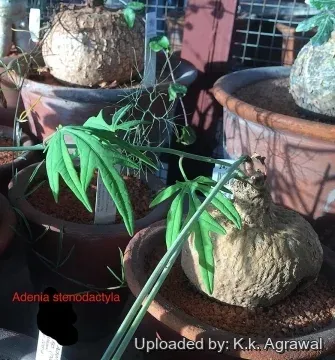
Description
Sowing dates
Sowing the seeds of Adenia stenodactyla is best carried out during the spring or early summer months when daylight hours are longest to ensure successful germination.
Prior to sowing, it is advisable to soak the seeds in warm water or a diluted growth stimulant solution for 2 to 4 hours to soften the seed coat.
Seeds should be planted at a depth of no more than 0.5–1 cm into a light, well-draining sandy-peat substrate that must be kept moderately moist.
Germination requires consistently high temperatures ranging between +25°C and +28°C, with bottom heat being highly beneficial for the process.
Containers must be covered with glass or clear plastic to maintain high humidity, while daily ventilation is essential to prevent fungal infections.
Growing requirements
Adenia stenodactyla is a member of the Solanaceae family and is known as a unique caudex-forming succulent adapted to arid environments.
This plant thrives in bright, intense light, ideally receiving direct sunlight during the early morning or late afternoon to avoid leaf scorch.
The potting medium must be highly porous; the addition of coarse sand, perlite, or fine gravel to the soil mixture is mandatory for proper drainage.
During the active growing season, watering should be regular but cautious: allowing the soil to dry out between watering sessions is critical to preventing root rot.
In winter, the plant requires a marked dormancy period with temperatures reduced to around +15°C and minimal to no soil moisture provided.
Main diseases and pests
Root rot is the primary threat to this species, usually caused by overwatering or poor drainage leading to stagnant water in the substrate.
In indoor conditions, Adenia stenodactyla can be susceptible to common pests like spider mites, especially if the ambient air is excessively dry.
Mealybugs frequently infest the leaf axils and soft stem tissues, feeding on sap and significantly hindering the overall health and vigor of the plant.
Control of insect pests is best achieved through the use of systemic insecticides, while fungal issues should be addressed with copper-based fungicides.
Proactive care, such as ensuring proper airflow and never leaving the pot sitting in a saucer of water, is the best defense against diseases.