
Zannichellia palustris
Zannichellia palustris
Description
How to tell it apart
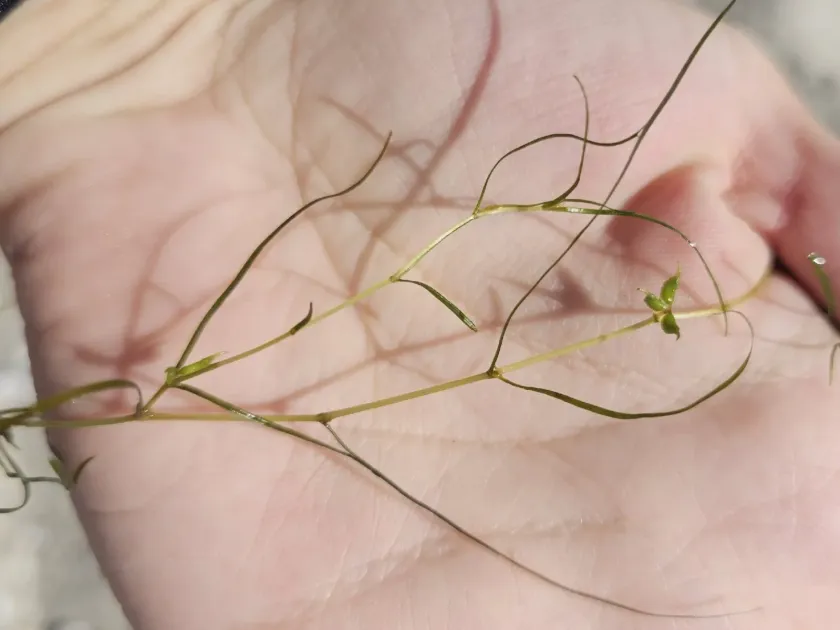
Zannichellia palustris, commonly known as horned pondweed, is a submerged aquatic plant belonging to the Potamogetonaceae family. It is a perennial herb characterized by thin, thread-like stems that can grow between 10 to 50 centimeters in length.
The leaves are linear, opposite or whorled, and almost translucent with a single central vein. Because of this structure, it is often confused with various pondweed species, though it is noticeably more fragile and delicate in its appearance.
The flowers are tiny, unisexual, and inconspicuous, developing in the leaf axils. Pollination occurs entirely underwater, which is a specialized biological feature of this aquatic plant species.
Its fruits are small, slightly curved nutlets often possessing a toothed margin, which helps them attach to substrates or wildlife, facilitating their spread throughout the water body.
The plant possesses a well-developed root system with slender, creeping rhizomes that allow it to colonize muddy or sandy bottoms rapidly and anchor itself firmly against water movement.
Where it grows
Horned pondweed typically inhabits standing or slow-moving freshwater and brackish environments. It is widely distributed across the temperate regions of Eurasia and North America, frequently found in ponds, lakes, ditches, and river backwaters.
In agricultural settings, it is a significant nuisance in irrigation canals, drainage networks, and paddy fields, where consistent water availability creates ideal conditions for its proliferation.
The species thrives at depths ranging from 20 to 100 centimeters, preferring silty or nutrient-rich substrates that support its rapid vegetative growth throughout the season.
Zannichellia palustris is highly resilient to fluctuating water levels. It can survive short periods of drought by dormant seed banks, allowing it to recover quickly as soon as the canal or water body is refilled.
Its ability to tolerate brackish water makes it a persistent weed in arid regions where irrigation water may have high mineral content, outcompeting other native aquatic plants.
Harm it causes
The primary agricultural impact of Zannichellia palustris is the clogging of irrigation and drainage infrastructure. Dense mats of the weed impede water flow, significantly reducing the efficiency of water delivery to crops.
In rice cultivation, horned pondweed acts as an aggressive weed that competes with the crop for light, mineral nutrients, and space, particularly during the early stages of the rice life cycle.
Heavy infestations lead to increased siltation within canals as the plant traps sediment. This necessitates more frequent dredging and mechanical cleaning, increasing the maintenance costs for irrigation districts.
The stems of the plant are known to clog pump intakes and tangle in mechanical irrigation equipment, leading to frequent operational failures, engine overheating, and expensive machinery repairs.
Large-scale decomposition of the plant biomass at the end of the season can lead to water quality degradation, potentially introducing harmful bacteria or reducing oxygen levels in the water supply.
How to control
Mechanical control is a foundational approach, involving the dredging of canals to remove nutrient-rich silt deposits where the weed's seeds and rhizomes accumulate.
Implementing a dry-out cycle for irrigation canals during the off-season is highly effective. Exposing the bottom substrate to drying or freezing conditions significantly reduces the viability of the plant's propagules.
Chemical control can be employed using aquatic-approved herbicides; however, this requires precise application to ensure effectiveness while minimizing risks to the surrounding environment and downstream water users.
Biological control methods, such as stocking canals with grass carp (Ctenopharyngodon idella), provide a natural and sustainable way to manage population levels by grazing on the plant’s succulent stems.
- Mechanical harvesting using aquatic weed mowers.
- Off-season canal drainage and desiccation.
- Targeted application of selective aquatic herbicides.
- Stocking with herbivorous fish species for natural control.
- Regular surveillance of canal flow to detect early infestations.
Taxonomy
- Latin name
- Zannichellia palustris
- Family
- Рдестовые
- EPPO code
- ZAIPA