
Sharp-leaved pondweed
Potamogeton acutifolius
Description
How to tell it apart
Sharp-leaved pondweed belongs to the Potamogetonaceae family. It is a perennial submerged aquatic plant that lives entirely beneath the water surface.
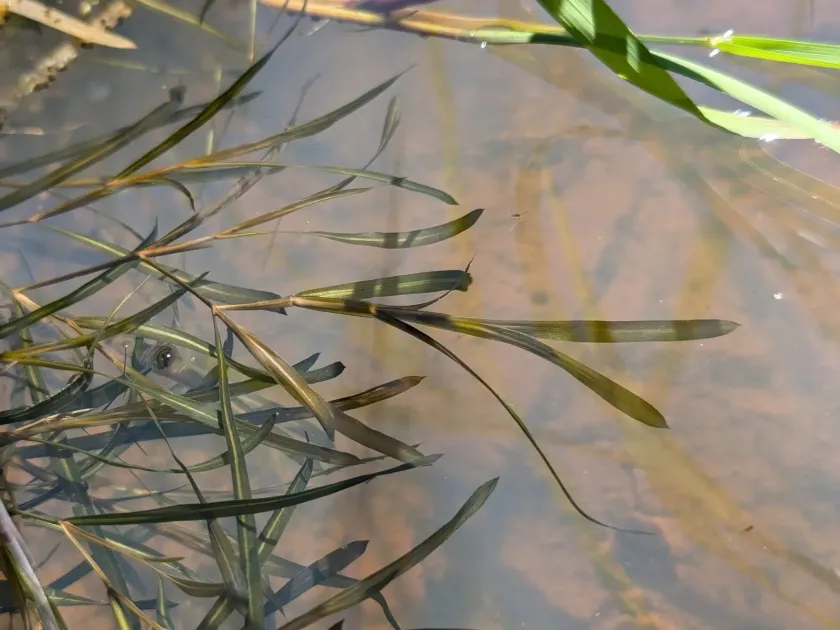
The plant features a thin, slightly flattened stem that branches extensively near the top. The leaves are narrow, linear, and characteristically sharp-pointed at the apex.
A key morphological feature is the presence of one distinct mid-vein and two lateral veins, clearly visible when the leaf is held up to the light.
The species possesses a well-developed, creeping rhizome that anchors the plant in the substrate and facilitates aggressive vegetative propagation.
Flowers are tiny and arranged in spike-like inflorescences that emerge above the water surface during the flowering period to enable wind-assisted pollination.
Where it grows
This species primarily inhabits freshwater bodies with still or slow-moving water, including ponds, lakes, and drainage or irrigation canal systems.
It prefers muddy or sandy-silty substrates that are rich in organic matter. Optimal growth occurs at depths ranging from 0.5 to 2 meters.
In agriculture, it is recognized as a major weed in irrigation networks, as it colonizes channels and restricts water flow during critical growing seasons.
The plant demonstrates high adaptability, enduring fluctuating water levels, which makes it particularly difficult to manage in managed hydraulic systems.
Spread is achieved through both seeds, which travel via water currents, and vegetative fragments of rhizomes that readily establish in new locations.
Harm it causes
The primary detrimental impact is the rapid overgrowth of water channels, which leads to significant obstruction and reduced water delivery speed.
Dense mats of pondweed trap sediments and debris, causing accelerated silting of irrigation channels and reducing the overall efficiency of the infrastructure.
During the irrigation season, thick vegetation hinders the delivery of water to fields, potentially causing crop failure or water stress in managed farmlands.
Large-scale decomposition of plant matter consumes dissolved oxygen, which can cause significant ecological imbalance and threaten local aquatic life.
The presence of this weed increases operational maintenance costs, as specialized equipment is required to clear clogged pumps and water intake structures.
How to control
Mechanical harvesting remains the standard approach for weed management. Specialized underwater mowers and rakes are used to clear the biomass from channels.
Cultural control methods involve regular drying of irrigation canals during the off-season. Complete desiccation of the channel bed kills rhizomes.
Chemical control involves the use of aquatic-approved herbicides. This approach requires extreme caution to prevent environmental damage to water supplies.
Effective management requires a comprehensive approach, combining periodic cleaning with structural improvements to the channel flow dynamics.
- Regular mechanical harvesting;
- Seasonal canal drying and desiccation;
- Use of permitted aquatic herbicides;
- Preventative maintenance of water infrastructure.
Taxonomy
- Latin name
- Potamogeton acutifolius
- Family
- Рдестовые
- EPPO code
- PTMAC