
Spermacoce prostrata
Spermacoce prostrata
Description
How to tell it apart
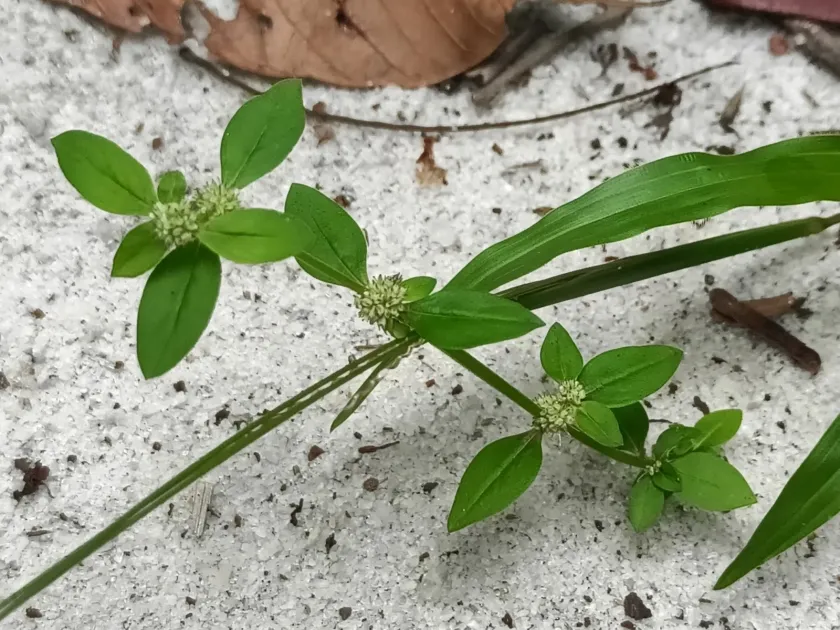
Spermacoce prostrata, a member of the Rubiaceae family, is an annual herbaceous weed. It is characterized by its prostrate or spreading stems that frequently root at the nodes when in contact with the soil.
The leaves are opposite, elliptic to lanceolate in shape, with a distinct venation pattern. The surface of the leaves can be slightly pubescent, often with rough margins that are tactilely noticeable.
Its flowers are small, white, and clustered in dense, head-like inflorescences located in leaf axils or at the tips of the shoots. The four-lobed corolla is a diagnostic feature of the genus.
The root system is well-developed, allowing the plant to anchor effectively and form dense mats, which is a major reason for its rapid expansion across arable lands.
The plant produces small capsules that split into two parts, releasing numerous seeds. This prolific seed production contributes significantly to its status as a persistent agricultural weed.
Where it grows
Spermacoce prostrata prefers moist, well-lit environments. It is commonly found in row crops, vegetable plantations, orchards, and along roadsides or in disturbed wasteland areas.
The weed thrives in loose, fertile soils where moisture is abundant. It is particularly problematic in irrigated agriculture, where favorable growing conditions persist throughout the season.
It acts as a serious competitor in fields of corn, soybeans, cotton, and various vegetable crops. Due to its creeping growth habit, it can quickly occupy spaces between crop rows.
The species is highly adaptive to tropical and subtropical climates, allowing it to dominate areas where natural competition from other plant species is low.
Its occurrence is frequently associated with poor sanitation practices and the movement of contaminated agricultural equipment between fields, which facilitates its spread.
Harm it causes
The primary damage caused by Spermacoce prostrata is its aggressive competition for water, sunlight, and soil nutrients. Dense growth can severely stunt the development of young crops.
The weed creates a physical barrier that complicates mechanical field operations. Large masses of the plant can clog harvesting machinery, leading to increased wear and decreased operational efficiency.
The dense cover of the weed increases humidity in the microclimate near the soil surface, which often promotes the incidence of various fungal diseases affecting the main crop.
Because the plant can regrow from stem fragments, ineffective mechanical tillage can sometimes exacerbate the infestation rather than eliminate it.
Ultimately, high infestation levels lead to reduced crop yields and higher production costs due to the need for multiple herbicide applications or manual labor to manage the weed.
How to control
Effective control strategies start with good cultural practices, such as deep autumn plowing to bury seeds and intensive inter-row cultivation to eliminate young sprouts.
Crop rotation with competitive species that provide good canopy cover can help suppress the growth of this light-demanding weed by limiting its access to solar radiation.
Chemical control involves the use of pre-emergence and post-emergence herbicides. Choosing the right active ingredient is crucial, and tank mixes are often recommended for resistant populations.
Strict hygiene protocols, including cleaning farm machinery after moving from infested areas to clean ones, are essential to prevent the introduction of new weed seeds.
- Regular mechanical cultivation between crop rows.
- Application of selective systemic herbicides during the early growth stages.
- Maintaining high soil fertility to promote rapid crop emergence and growth.
Taxonomy
- Latin name
- Spermacoce prostrata
- Family
- Мареновые
- EPPO code
- SPCPR