
Spermacoce articularis
Spermacoce articularis
Description
How to tell it apart
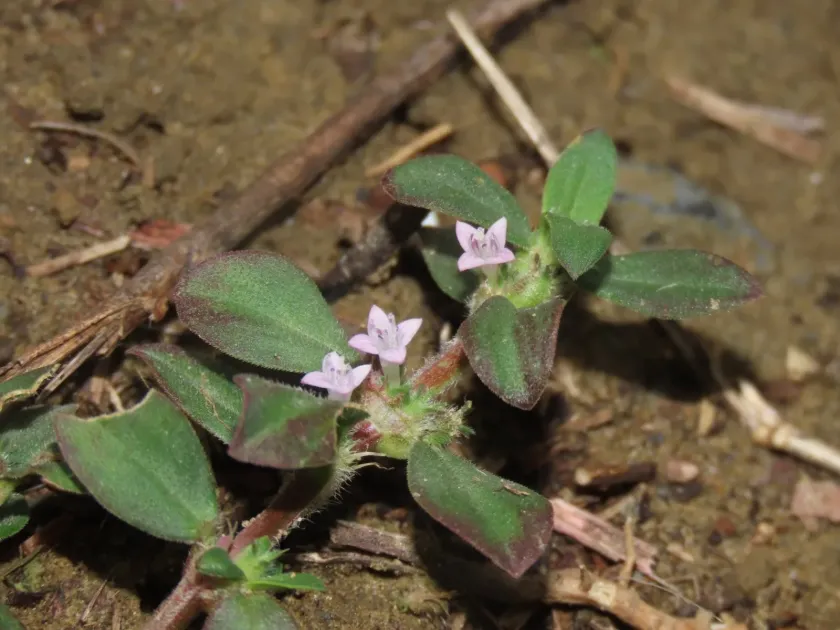
Spermacoce articularis is an annual herbaceous weed belonging to the Rubiaceae family, characterized by its prostrate or ascending stem growth.
The plant features opposite, lanceolate to elliptical leaves with prominent veins, making it recognizable in early development stages.
Its flowers are small, white, and organized in axillary clusters, which bloom during the active growing season of the crop.
The root system is tap-rooted and quite resilient, enabling the plant to establish itself in various soil types and competitive conditions.
The fruit is a dry capsule that splits upon maturity to release numerous seeds, ensuring a high reproductive rate for the next season.
Where it grows
This weed is native to tropical and subtropical regions, frequently found in parts of Asia, Australia, and Africa.
It thrives in open fields, particularly in irrigated agricultural lands like rice paddies and plantation crops.
Spermacoce articularis readily colonizes disturbed areas such as roadsides, irrigation canals, and fallow lands.
It shows significant adaptation to diverse soil conditions, including sandy loams and nutrient-rich clays used for farming.
The distribution is largely aided by water and machinery, which spread the seeds across fields and into pristine cultivation areas.
Harm it causes
The primary impact of this weed is its ability to compete for essential sunlight, moisture, and soil nutrients, reducing crop yield.
Its high seed production capacity creates a persistent seed bank in the soil that requires multiple years of control to deplete.
Allelopathic properties of the weed can suppress the germination and growth of neighboring crops, impacting overall field productivity.
The density of these weeds can physically obstruct mechanical harvesting equipment, leading to significant post-harvest losses.
It serves as an alternative host for various crop pathogens and insects, complicating the integrated pest management of the field.
How to control
Cultural control practices, such as deep plowing and crop rotation, are essential for reducing the population of seedlings in the field.
Mechanical control through inter-row cultivation is highly effective when performed during the early, tender stages of the weed's growth.
Chemical control should be implemented using selective systemic herbicides during the active growth phase before the weed sets seeds.
Integrated weed management must prioritize cleaning equipment between fields to prevent the spread of seeds across the farm.
- Use of competitive crop cultivars.
- Prompt removal of seedlings in early stages.
- Application of suitable pre-emergence herbicides.
- Strict field perimeter maintenance.
Taxonomy
- Latin name
- Spermacoce articularis
- Family
- Мареновые
- EPPO code
- BOIAR