
Diodia teres
Diodia teres
Description
How to tell it apart
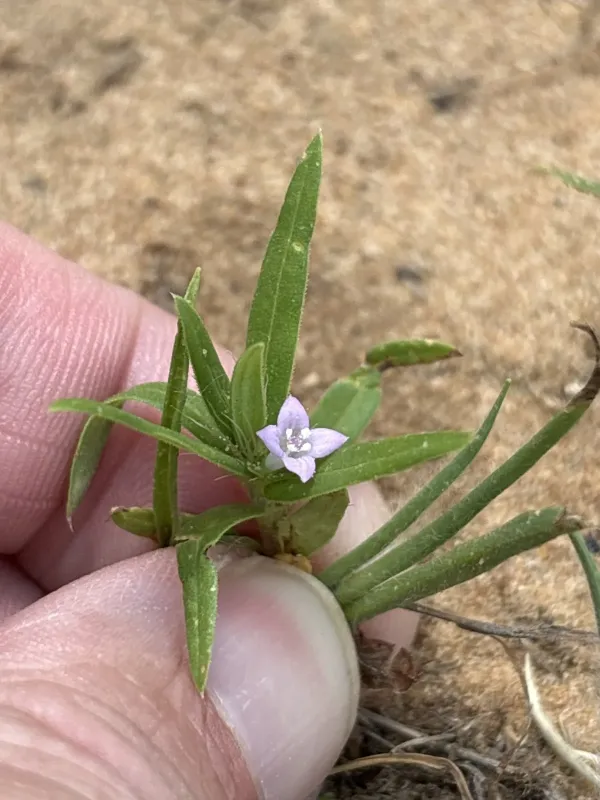
Diodia teres, commonly known as rough buttonweed, is an annual herbaceous plant belonging to the Rubiaceae family. The plant features a characteristic erect or spreading stem with a distinct four-angled cross-section.
Its leaves are opposite, narrow, and lanceolate, accompanied by stipules that form a sheath with long bristles. This feature is a primary diagnostic characteristic for species identification in the field.
The flowers are small, ranging from white to pink or light purple, and are situated in the leaf axils. They are typically sessile, giving the plant a compact and button-like appearance during the flowering phase.
The taproot system is capable of growing deep into the soil, providing the weed with significant resilience against environmental stressors like drought.
The seeds are equipped with appendages that facilitate dispersal via wind, water, and agricultural equipment, which contributes to the rapid spread of the species across cultivation areas.
Where it grows
This weed prefers well-drained, sandy, and loamy soils and is frequently found in areas with disturbed soil surfaces, such as roadside verges and fallow land.
In agricultural settings, Diodia teres poses a major challenge for soybean, peanut, corn, and cotton production, often infiltrating field edges and interior patches.
The species exhibits high ecological plasticity, allowing it to adapt to various climatic conditions ranging from humid temperate regions to drier environments.
Because of its ability to rapidly colonize open soil, it often outcompetes less vigorous plant species during the early developmental stages of crops.
It is commonly found in abandoned pastures and non-crop areas, serving as a source for re-infestation of adjacent productive agricultural land.
Harm it causes
The primary damage caused by Diodia teres is its intense competition for sunlight, water, and soil nutrients, which directly translates to reduced crop yields.
This weed acts as a reservoir for several viral and fungal pathogens, which can then spread to economically significant crops and impact overall field health.
The presence of this weed interferes with mechanical harvesting operations and can contaminate the harvested product, increasing processing and cleaning costs.
Heavy infestations significantly suppress the growth of young crop seedlings, as the weed quickly establishes itself in the absence of dense canopy coverage.
Due to high seed production, a single plant can build an extensive seed bank in the soil, leading to persistent emergence cycles over several subsequent growing seasons.
How to control
Agrotechnical management includes frequent disk tilling and deep plowing to effectively destroy young seedlings before they reach the flowering stage.
Crop rotation incorporating species that develop a rapid and dense canopy cover helps to suppress the growth of this weed through light competition.
Chemical control strategies rely on the application of systemic herbicides that are absorbed through the foliage and translocated to the deep taproot.
The most effective results are typically achieved by timing herbicide applications during the early vegetative growth stages before the weed develops a thick, waxy cuticle.
- Hand-weeding or manual removal for localized infestations.
- Use of glyphosate-based herbicides on fallow or pre-planting sites.
- Application of selective post-emergence herbicides in broadleaf crop stands.
Taxonomy
- Latin name
- Diodia teres
- Family
- Мареновые
- EPPO code
- DIQTE