
False cleavers
Galium spurium
Description
How to tell it apart
False cleavers (Galium spurium) is an annual herbaceous plant belonging to the Rubiaceae family. It is frequently confused with the closely related cleavers (Galium aparine), though it is morphologically distinct in its floral and fruit structures.
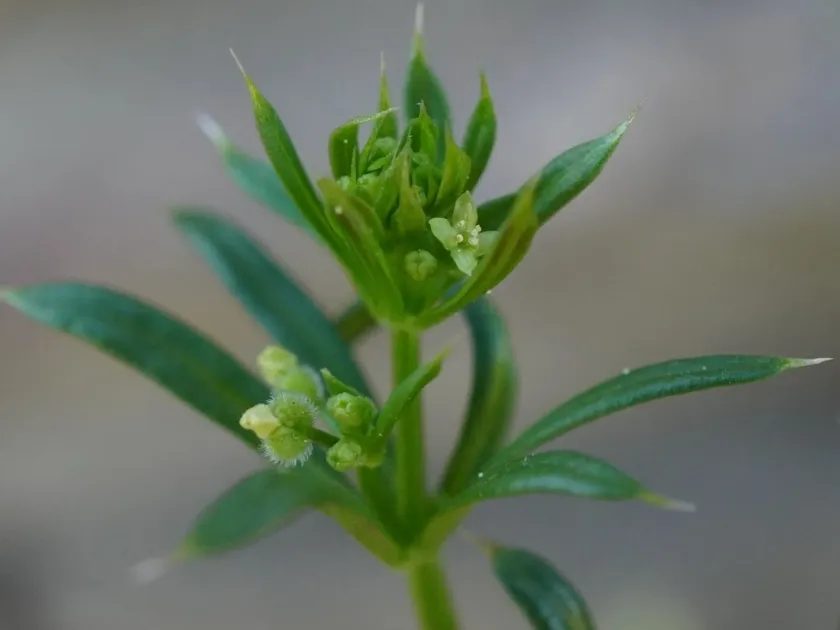
The stems of the plant are weak, square, and ascending, typically reaching 30–60 cm in height. They are covered with tiny, downward-pointing prickles that allow the plant to cling to other structures and crops.
The leaves are lanceolate or linear-lanceolate, arranged in whorls of 6 to 8 around the stem. Their margins are rough to the touch due to the presence of small, stiff hairs.
Tiny, greenish-white flowers appear in axillary cymes from early summer through autumn. The plant is self-compatible, allowing it to produce seeds even in low-density populations.
The fruit is a small, two-lobed schizocarp covered with hooked hairs. These hooks are highly efficient at adhering to clothing, fur, and machinery, facilitating the dispersal of seeds over large areas.
Where it grows
This weed thrives in nutrient-rich, moist soils and is commonly found in temperate agricultural regions. It has a high preference for nitrogen-rich environments, such as cultivated fields and roadsides.
It acts as a significant weed in cereal crops, oilseed rape, sugar beet, and maize. In fields with sparse crop stands, it can quickly establish dense mats that outcompete the desired crops for resources.
False cleavers is well-adapted to different soil types and can emerge from depths of up to 5 cm. Its ability to overwinter as a small rosette allows it to colonize winter-sown cereal fields effectively.
The weed is frequently found on fallow lands and field margins, which serve as reservoirs for seeds that are subsequently transported into active crop areas via wind, water, or farm equipment.
Due to its opportunistic nature, it rapidly colonizes areas where soil management is suboptimal or where crop rotations are not strictly followed.
Harm it causes
The primary damage caused by False cleavers is through direct competition for sunlight, water, and nutrients. Its vining habit allows it to climb on cereal stalks, often causing the crop to lodge.
Lodging leads to increased humidity within the crop canopy, which significantly raises the risk of fungal infections and diseases in the cereal grains.
During harvest, the high biomass of the weed interferes with machinery. It clogs harvesting equipment, which increases downtime and results in grain with higher moisture content and lower quality.
Contamination of grain batches with False cleavers seeds is a major economic issue. The seeds are particularly difficult to remove from oilseed rape, lowering the market value of the commodity.
Additionally, the weed acts as an alternative host for several pests and pathogens, which can migrate to crops, further exacerbating the phytosanitary pressure on the field.
How to control
Crop rotation is a fundamental management practice. By altering the timing of planting and cultivation, farmers can disrupt the life cycle of this weed and prevent it from becoming established.
Mechanical control involves thorough soil preparation, including deep plowing and timely cultivation. These methods destroy young seedlings before they develop a strong root system or start to branch.
Chemical control is most effective when herbicides are applied during the early growth stages of the plant, specifically when it has between 2 and 4 whorls of leaves.
Preventative measures, such as cleaning agricultural machinery and ensuring the purity of sowing seeds, are critical in limiting the spread of the plant to new fields.
- Regular monitoring of field edges to prevent early colonization.
- Usage of selective herbicides suitable for the specific crop variety.
- Early spring harrowing to eliminate seedlings in winter crops.
- Strategic fallowing or use of cover crops to suppress weed emergence.
Taxonomy
- Latin name
- Galium spurium
- Family
- Мареновые
- EPPO code
- GALSA