
Nertera granadensis
Nertera granadensis
Description
How to tell it apart
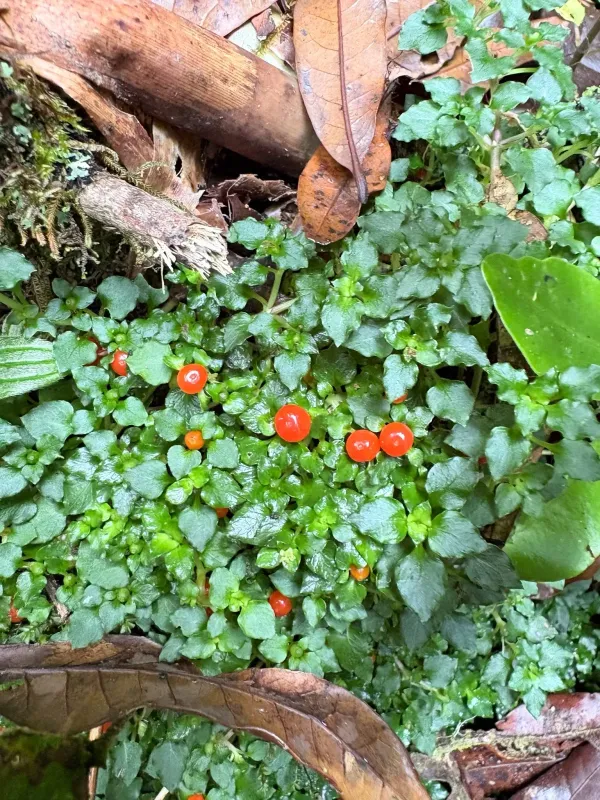
Nertera granadensis, commonly known as the coral moss or bead plant, is a mat-forming perennial herb belonging to the Rubiaceae family. It is characterized by its prostrate, creeping growth habit.
The stems are thin, delicate, and highly branched, with the ability to root at every node. This creates a dense, carpet-like mat that can easily cover large areas of soil surface in a short period.
Leaves are small, opposite, and usually round or ovate, maintaining a glossy, bright green appearance throughout the growing season.
While the flowers are inconspicuous and small, the plant is famous for its vibrant orange to coral-red berries that develop across the entire mat, making the plant very easy to distinguish from other weeds.
The root system is fibrous and shallow, spreading rapidly through the top layer of soil, which allows it to thrive in dense clusters that are difficult to eradicate manually.
Where it grows
Originating from Central and South America, Nertera granadensis has naturalized in various temperate regions, often becoming a persistent weed in nurseries, greenhouses, and moist, shaded fields.
It favors moist, slightly acidic, and humus-rich soils. It is particularly common in areas with low light intensity and consistent soil moisture, often found along irrigation ditches.
In agricultural settings, it thrives in the understory of orchards or in spaces between crop rows that receive regular irrigation and shade from the canopy.
It is rarely found in dry, open fields, but it can quickly become an invasive pest in managed horticultural environments where humidity levels are high.
The plant is highly adaptable to microclimates where competition from taller weeds is minimal, allowing it to establish a dominant presence on the soil surface.
Harm it causes
The primary harm caused by Nertera granadensis is its aggressive competition for surface nutrients and water, which stunts the growth of young seedlings and delicate crop plants.
By forming a thick mat on the soil surface, it restricts oxygen exchange, leading to poor soil aeration and an increased risk of root rot pathogens developing in the crop's root zone.
It acts as a physical barrier for new plantings, preventing effective seed germination and forcing growers to dedicate extra time to manual weeding and site maintenance.
Because it is a member of the Rubiaceae family, it can harbor specific pests and diseases that may spread to valuable economic crops, increasing the risk of widespread infections.
In high-density cultivation areas, the presence of this weed increases operational costs, as it complicates mechanical weeding and requires more frequent chemical interventions.
How to control
Effective control starts with cultural practices such as deep plowing or soil cultivation to break up the dense root mats and expose the plants to desiccation by the sun.
Managing soil moisture levels is critical; reducing excess irrigation and improving drainage in greenhouse or nursery environments can significantly limit its spread.
Mulching is a highly effective method to suppress growth, as covering the soil with organic or synthetic barriers prevents the necessary light exposure required for the plant's survival.
Chemical control can be achieved through the application of broad-spectrum herbicides during the active growth phase, though precision spraying is recommended to protect surrounding crops.
- Regular mechanical hoeing and removal of the creeping stems before the berry-bearing phase.
- Spot-treatment with systemic herbicides in heavily infested areas to ensure deep root kill.
- Implementation of strict sanitation protocols for incoming soil and plant materials to prevent further infestation.
Taxonomy
- Latin name
- Nertera granadensis
- Family
- Мареновые
- EPPO code
- NETGR