
Sweet woodruff
Galium odoratum
Description
How to tell it apart
Sweet woodruff (lat. Galium odoratum) is a herbaceous perennial plant belonging to the Rubiaceae family. In an agricultural context, it is considered a rhizomatous perennial weed.
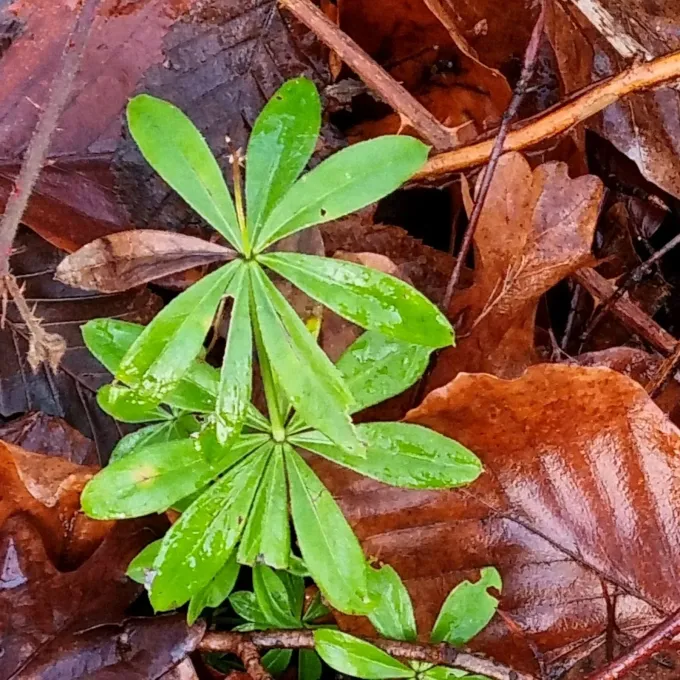
The plant features a square-shaped, smooth stem growing 15 to 40 cm tall. Leaves are arranged in whorls of 6 to 8, possessing a lanceolate shape with slightly rough margins.
The most distinctive characteristic of this plant is its strong, sweet coumarin scent, which is particularly pungent when the plant is harvested and begins to wilt.
Small white flowers are arranged in loose, terminal cymes. They typically bloom in late spring, creating a white carpet in favorable forest-like environments.
It propagates via a creeping, thin, and highly branched root system, which allows it to spread rapidly across damp soil, forming dense patches that crowd out other plants.
Where it grows
Sweet woodruff thrives in moist, shady, and nutrient-rich soils. In natural settings, it is a common inhabitant of deciduous forests and shrublands.
As an agricultural weed, it frequently colonizes fields located near woodlands or on low-lying, poorly drained terrain where humidity remains high throughout the season.
It is particularly problematic in winter cereals, perennial grass fields, and orchards where dense canopy coverage provides the necessary shade for its proliferation.
The plant is highly adaptive to various soil types, provided that a sufficient moisture level is maintained to support its extensive root system.
Agricultural equipment often acts as a vector for dispersal, as tillage tools can break and redistribute pieces of the rhizome across different parts of the field.
Harm it causes
The primary harm caused by sweet woodruff is its intense competition with crops for soil nitrogen, water, and essential nutrients during the critical growth phases.
By forming dense mats of vegetation, it suppresses the development of crop seedlings, leading to reduced plant density and uneven maturation of the crop.
The presence of this weed in fodder crops can degrade the overall quality of hay, as it may affect the nutritional value and palatability of the feed for livestock.
Increased density of the weed on the field creates difficulties during the harvest phase, as the creeping stems can interfere with combine headers and increase operational time.
Infested areas experience a notable reduction in total yield, often ranging from 10% to 25%, depending on the duration of weed competition and climatic conditions.
How to control
Effective agrotechnical management involves deep plowing with soil inversion, which is essential to expose the root system to drying and reduce its vigor.
Crop rotation incorporating broad-leaf crops that require intensive inter-row cultivation helps to mechanically disturb and eliminate the rhizome network.
Chemical control strategies utilize systemic herbicides, specifically targeting broad-leaved weed species, applied during the active growth phase of the crop.
Pre-sowing applications of non-selective herbicides, such as glyphosate-based products, are highly effective in clearing infested fields before the establishment of main crops.
Monitoring field margins and adjacent areas is crucial to prevent the encroachment of sweet woodruff into high-value agricultural plots and maintain clean fields.
Taxonomy
- Latin name
- Galium odoratum
- Family
- Мареновые
- EPPO code
- GALOD