
Virginia buttonweed
Diodia virginiana
Description
How to tell it apart
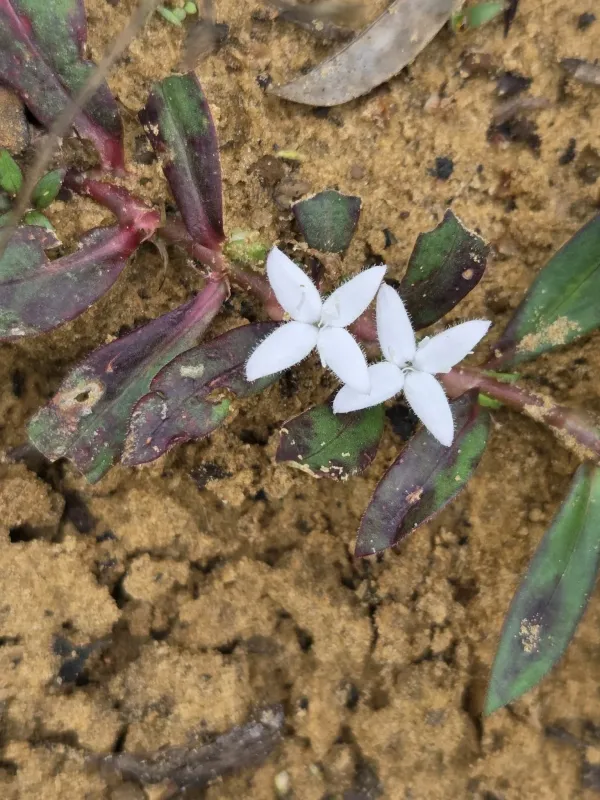
Virginia buttonweed (Diodia virginiana) is a perennial herbaceous plant belonging to the Rubiaceae (madder) family, characterized by its prostrate or ascending stems that root at the nodes.
The leaves are opposite, lanceolate, and pointed, featuring stipules that fuse into a membranous sheath with long bristles, a diagnostic trait of the family.
Its flowers are small, white to pale pink, four-petaled, and typically emerge from the leaf axils either individually or in small clusters.
The fruit is a dry capsule that splits into two nutlets at maturity; these segments are buoyant, allowing the plant to spread rapidly through water movement.
The plant possesses a robust root system, including an extensive creeping rhizome, which grants it high resilience and the ability to regenerate even after mechanical damage.
Where it grows
This species thrives in moist to wet habitats, including riverbanks, drainage ditches, low-lying field areas, and irrigated rice paddies.
It spreads aggressively in saturated soil conditions, quickly colonizing large areas through both vegetative propagation from stem fragments and seed dispersal.
Virginia buttonweed is particularly problematic in heavy clay soils where poor drainage leads to water accumulation, creating ideal conditions for its proliferation.
While it prefers wetlands, it has shown high adaptability, spreading into various soil types and becoming a major concern in irrigated agricultural landscapes.
In recent years, the weed has expanded its range significantly, adapting to diverse environmental stressors and posing challenges to modern farming systems.
Harm it causes
The primary harm caused by Virginia buttonweed is its intense competition for nutrients, light, and water, which severely stunts the growth of adjacent crops.
Due to its ability to form dense, mat-like colonies, it can easily choke out desirable crops, leading to significant reductions in total crop yield.
In rice production, it is regarded as a highly destructive weed because it thrives alongside the crop even in permanent flood conditions.
The weed acts as an alternative host for various pests and pathogens, increasing the overall risk of disease transmission within the cultivated area.
Furthermore, its presence interferes with mechanical harvesting operations, as the thick biomass clogs machinery and increases the moisture content of harvested grain.
How to control
Mechanical control focuses on improving field drainage to eliminate standing water and performing deep tillage to disrupt and break up the rhizome networks.
Crop rotation remains a crucial strategy, specifically integrating dryland crops to break the moisture-dependent life cycle of this weed.
Chemical control requires the application of systemic herbicides, as the plant's extensive rhizome system makes it highly resistant to surface-acting agents.
Using tank-mixed systemic herbicides, particularly those with hormonal activity, is often necessary to achieve effective systemic control of the entire plant.
- Frequent scouting and monitoring of fields before flowering begins.
- Strict adherence to herbicide application timings for maximum efficacy.
- Maintaining irrigation infrastructure to prevent seed spreading via water flow.
Taxonomy
- Latin name
- Diodia virginiana
- Family
- Мареновые
- EPPO code
- DIQVI