
Spermacoce ocymoides
Spermacoce ocymoides
Description
How to tell it apart
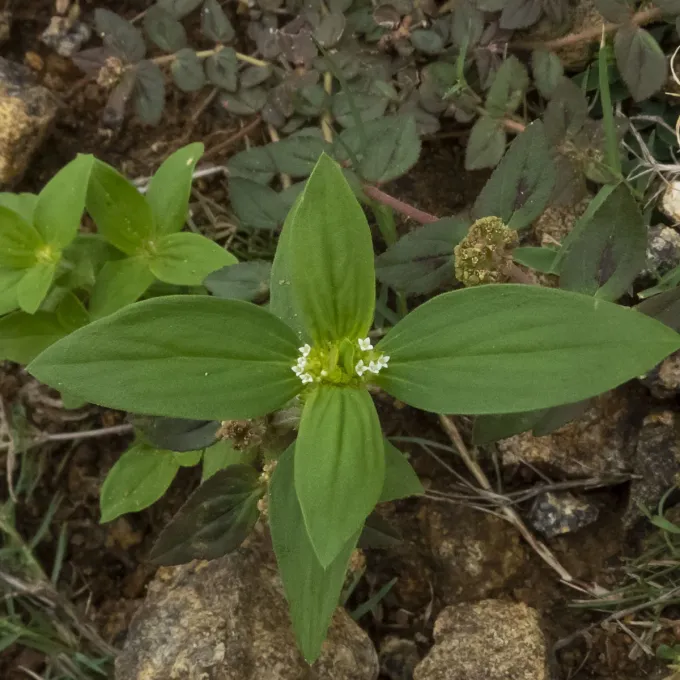
Spermacoce ocymoides is a species belonging to the Rubiaceae family. This annual herbaceous plant features an erect or branching stem that can reach heights of up to 50 cm.
The leaves are opposite, lanceolate or ovate in shape, pointed at the apex, and display characteristic venation. The leaf surface often feels slightly rough due to the presence of fine hairs.
The flowers of this species are small, gathered in dense, head-like inflorescences located in the leaf axils or at the tips of the shoots. The corolla is typically white and divided into four lobes.
The fruits are small, dry capsules that split open upon maturity, facilitating seed dispersal. The seeds are tiny, brown, and possess a high germination rate.
Biologically, this plant is a typical thermophilic weed that develops actively under conditions of sufficient moisture and high temperatures.
Where it grows
This weed is widely distributed in tropical and subtropical regions. In an agronomic context, it is encountered as an invasive species on agricultural lands.
Spermacoce ocymoides most frequently infests industrial crop plantations, vegetable fields, and cereal crops grown in hot climates.
The plant prefers well-lit areas with fertile, well-drained soils. It is often found along roadsides, on vacant lots, and in abandoned fields, from where it easily encroaches into cultivated agrocenoses.
High ecological plasticity allows this weed to adapt to various soil types, including sandy and loamy substrates, provided irrigation is available.
Under intensive farming practices, the weed quickly occupies free spaces between crop rows, especially if the canopy of the main crop fails to close completely.
Harm it causes
The harm caused by Spermacoce ocymoides lies in its active competition with cultivated plants for vital resources such as water, light, and mineral nutrients.
During the early stages of crop development, the weed can significantly suppress seedlings, leading to reduced plant density and a substantial decrease in potential yield.
The plant possesses high seed productivity, which contributes to the rapid accumulation of a seed bank in the soil layer, making eradication in subsequent seasons more difficult.
Beyond direct competition, the weed can serve as a reservoir for various pathogens and pests that may later migrate to the cultivated crops.
The presence of this weed complicates mechanized field maintenance and can degrade the quality of harvested produce if seeds contaminate the final crop yield.
How to control
The primary method of control is strict adherence to crop rotation, which prevents the accumulation of weed seeds in the soil by alternating crops.
Mechanical soil cultivation, including deep plowing and thorough pre-sowing tillage, allows for the effective destruction of seedlings and young plants before they can set seed.
A crucial practice is timely inter-row cultivation of row crops to prevent the expansion of weed patches.
Chemical control involves the use of systemic herbicides. The choice of product depends on the cultivated crop and the growth stage of the weed.
- Application of soil-applied herbicides before crop emergence.
- Use of post-emergence herbicides on actively growing weeds.
- Regular mowing on non-arable lands to prevent flowering and seed production.
Taxonomy
- Latin name
- Spermacoce ocymoides
- Family
- Мареновые
- EPPO code
- BOIOC