
Smooth buttonweed
Spermacoce glabra
Description
How to tell it apart
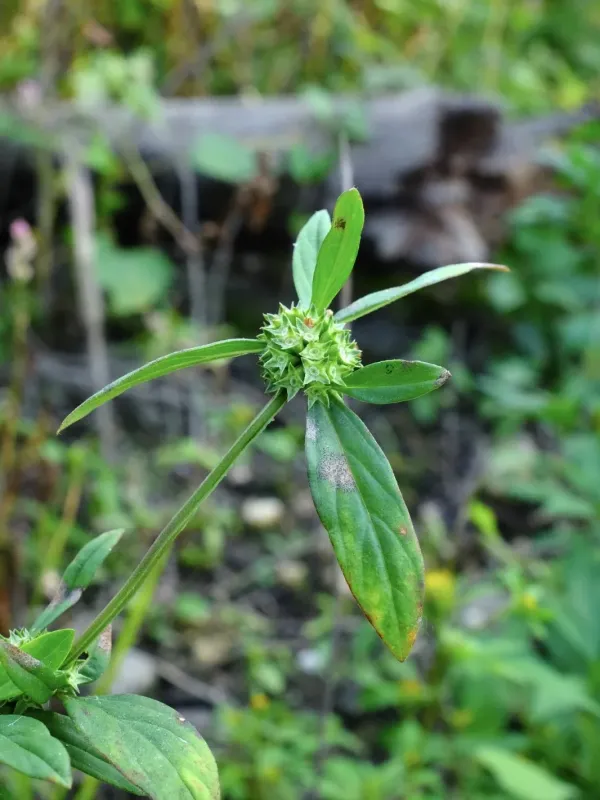
Smooth buttonweed (Spermacoce glabra) is a perennial herbaceous plant belonging to the Rubiaceae family, known for its ability to persist in moist environmental conditions.
The plant features quadrangular stems that are often decumbent, meaning they creep along the ground, which provides the plant with stability and allows it to spread effectively.
Leaves are lanceolate to elliptic in shape, arranged oppositely on the stem. A defining botanical characteristic is the stipules that fuse with the petioles, forming a sheath with distinct bristles.
The flowers are small, white, and organized into dense, globose clusters located in the leaf axils, blooming throughout the warmer months to ensure prolonged seed production.
The fruit is a small, dry capsule that dehisces at maturity, scattering seeds into the environment, which contributes to the plant's aggressive colonization potential.
Where it grows
Smooth buttonweed is primarily found in temperate and tropical regions, thriving in moist habitats such as riverbanks, wetlands, and low-lying areas of agricultural fields.
In farming systems, it is a significant nuisance in row crops like soybeans, corn, and cotton, where irrigation or high soil moisture provides ideal conditions for its growth.
The species is highly adaptable to disturbed habitats, frequently invading irrigation canals, drainage ditches, and field margins, from where it easily spreads to crop areas.
Human activity, particularly the movement of farm machinery between fields, is the primary vector for the dispersal of seeds across larger agricultural landscapes.
It prefers fertile, loamy soils, allowing it to compete effectively with high-value crops for soil nutrients and essential resources.
Harm it causes
The primary economic impact of smooth buttonweed is its competition with crops for water and nutrients, which directly translates into reduced plant vigor and lower final yields.
By forming dense patches, the weed shades out crop seedlings, preventing them from accessing sunlight during the critical early stages of development.
The presence of large populations of this weed complicates mechanical harvesting by interfering with machinery, which can lead to increased grain losses and damage to equipment components.
Additionally, the plant can harbor various agricultural pests and pathogens, serving as an alternative host that sustains these threats throughout the growing season.
- Direct competition for nutrient uptake in soybean and corn fields.
- Increased maintenance costs for irrigation and drainage infrastructure.
- Significant interference with combine harvesters.
- Lower quality of the harvested crop due to seed contamination.
How to control
Controlling smooth buttonweed requires a multi-pronged approach, focusing on preventive measures, mechanical cultivation, and strategic chemical applications.
Deep tillage is an effective method for burying seeds, significantly reducing their ability to germinate and emerge, provided the soil is managed properly thereafter.
Herbicide programs should prioritize pre-emergence applications to control early cohorts, followed by post-emergence treatments if necessary, using appropriate registered products.
Crop rotation with competitive, fast-growing species helps shade out the weed and disrupts its growth cycle, making the field environment less favorable for its establishment.
Strict sanitation protocols for farm equipment, such as cleaning machinery before moving to new fields, are essential to stop the spread of seeds from infested areas.
Taxonomy
- Latin name
- Spermacoce glabra
- Family
- Мареновые
- EPPO code
- SPCGL