
Schweinfurth's pondweed
Potamogeton schweinfurthii
Description
How to tell it apart
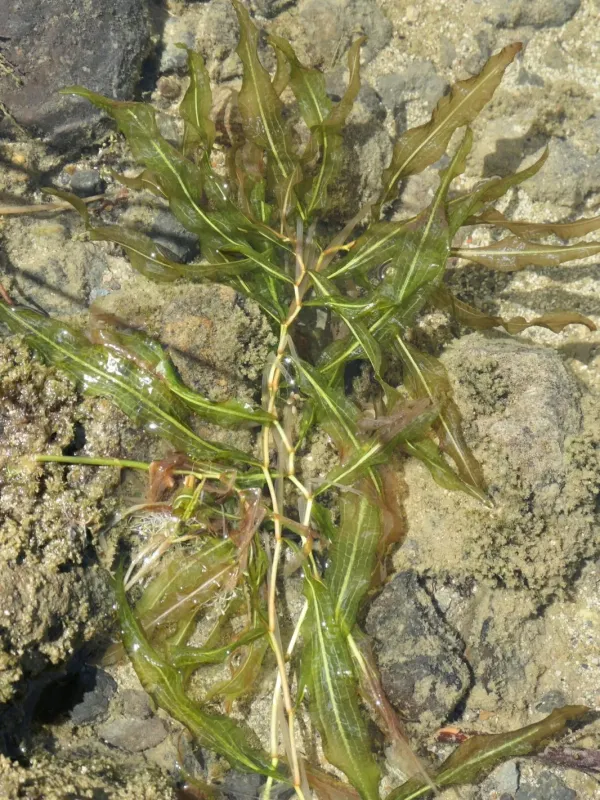
Schweinfurth's pondweed (Potamogeton schweinfurthii) is a perennial aquatic plant belonging to the Potamogetonaceae family, characterized by its fully submerged growth habit.
The plant features long, branched stems that can reach several meters in length, allowing it to form dense underwater mats in suitable aquatic environments.
Its leaves are alternate, oblong-lanceolate, often translucent, and can be either sessile or short-petiolate, providing a distinct appearance in the water column.
The inflorescences are dense spikes that emerge above the water surface during the flowering phase, although the plant primarily propagates via vegetative parts like rhizomes.
Unlike some other pondweed species, it typically lacks floating leaves, which makes it identifiable by its uniformly submerged structure within its habitat.
Where it grows
This species is commonly found in stagnant or slow-moving water bodies, including irrigation ditches, drainage canals, and agricultural wetlands.
It poses a significant threat to rice cultivation, as the permanently flooded conditions of rice paddies provide an optimal environment for its spread.
Schweinfurth's pondweed is native to parts of Africa and Asia, where it frequently invades hydro-technical infrastructure, hindering water flow management.
The plant thrives in nutrient-rich silty or clay substrates, which support its extensive root system and rapid biomass accumulation throughout the season.
Invasion often occurs through the movement of vegetative fragments and seeds transported by irrigation water from primary water sources into agricultural fields.
Harm it causes
The primary concern is the reduction of water flow velocity in irrigation networks, which leads to increased siltation and inefficiency of water distribution systems.
In rice fields, the weed competes directly with the crop for light, nutrients, and space, significantly suppressing the growth and yield of rice plants.
Dense mats of the weed obstruct mechanical operations, making maintenance of irrigation channels and harvesting of rice fields difficult and labor-intensive.
The decomposition of excessive plant material at the end of the season can deplete oxygen levels in the water, negatively impacting the local aquatic ecosystem.
The weed acts as a habitat for various pests and pathogens, increasing the risk of secondary infestations in agricultural crops throughout the growing cycle.
How to control
Agrotechnical management primarily involves routine physical clearing of canals and removing accumulated biomass before the start of the rice planting season.
Implementing crop rotation practices that include drying out the soil can help deplete the rhizomes of the plant, reducing its ability to regenerate.
Chemical control involves the application of registered herbicides that are specifically approved for use in aquatic environments to target the weed without harming the crop.
Biological control methods, such as the introduction of herbivorous fish species like grass carp, have been shown to be effective in managing biomass in confined water bodies.
Early detection and immediate removal of small patches of the weed are critical to preventing its rapid colonization and wider spread throughout irrigation networks.
Taxonomy
- Latin name
- Potamogeton schweinfurthii
- Family
- Рдестовые
- EPPO code
- PTMSC