
Shining pondweed
Potamogeton lucens
Description
How to tell it apart
Shining pondweed (Potamogeton lucens) is a perennial aquatic plant belonging to the Potamogetonaceae family, characterized by its fully submerged growth habit.
It features long, branched stems that can grow several meters in length, making it highly adaptive to varying water depths.
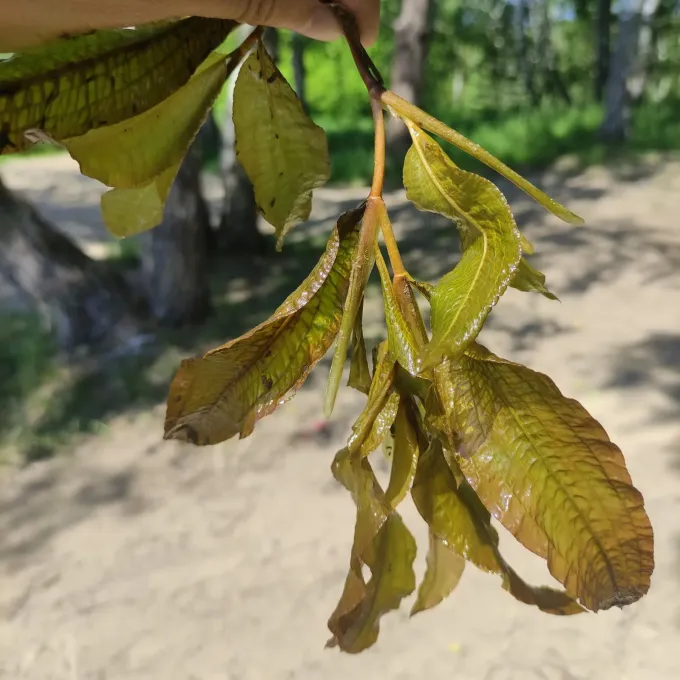
The leaves are large, lanceolate or elliptical, distinguished by their glossy surface and prominent midrib, which makes identification easier.
During the flowering season, it produces dense, cylindrical spikes that extend above the water surface to facilitate pollination.
The root system consists of creeping rhizomes that allow the plant to establish firm anchoring in substrates and survive through winter months.
Where it grows
This species thrives in stagnant or slow-moving freshwater environments, including lakes, ponds, rivers, and man-made irrigation canals.
It is particularly problematic in rice cultivation areas, where the controlled water levels of paddies provide an ideal environment for colonization.
Shining pondweed prefers silty or sandy-silty bottoms, allowing its rhizomes to spread rapidly and form dense, underwater colonies.
The plant is commonly found in irrigation systems, where it can quickly choke water flow and disrupt the distribution of water to agricultural fields.
Dispersal is primarily vegetative, with fragments of rhizomes transported by water currents or human activity such as canal maintenance.
Harm it causes
The primary concern with shining pondweed is its ability to reduce the flow capacity of irrigation canals, causing siltation and potential flooding.
In rice paddies, it competes aggressively with the crop for essential nutrients, light, and space, leading to significant yield losses.
Heavy infestations create obstacles for mechanical equipment used in field maintenance and harvesting, increasing operational costs for farmers.
The accumulation of decaying plant material from pondweed can lead to decreased water quality and oxygen depletion in the aquatic ecosystem.
Furthermore, dense stands act as a habitat for various pests and pathogens that may negatively affect cultivated crops in the vicinity.
How to control
Agrotechnical management includes periodic draining of canals and paddies, which exposes the rhizomes to air, leading to dehydration and death.
Mechanical control involves the use of aquatic weed harvesters, dredgers, or specialized cutting blades to remove the biomass from the system.
Chemical control relies on the application of systemic herbicides designed specifically for use in aquatic habitats to ensure effective eradication.
Preventive measures include regular inspection of water sources and maintenance of canal banks to limit the spread of rhizome fragments.
- Regular water drainage schedules.
- Mechanical removal of biomass.
- Targeted herbicide application during growth stages.
Taxonomy
- Latin name
- Potamogeton lucens
- Family
- Рдестовые
- EPPO code
- PTMLU