
Ribbon-leaf pondweed
Potamogeton epihydrus
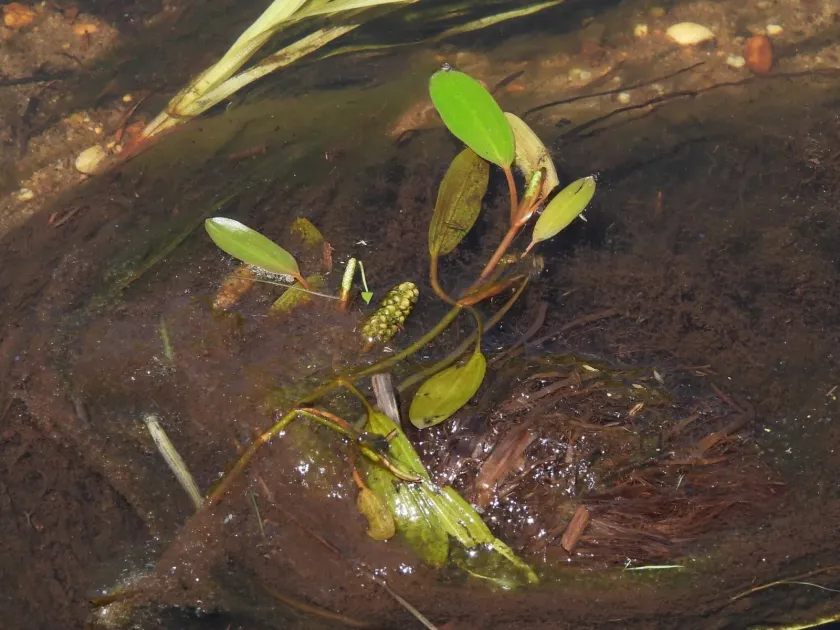
Description
How to tell it apart
Ribbon-leaf pondweed (Potamogeton epihydrus) belongs to the Potamogetonaceae family. It is a perennial aquatic plant that develops both underwater and on the water surface.
The plant features narrow, ribbon-like submerged leaves, while its floating leaves are elliptical and have a firm, leathery texture.
Stems can grow to considerable lengths, they are highly branched and rooted in the bottom sediment of water bodies or irrigation canals.
The root system consists of creeping rhizomes that provide stability against current and enable rapid vegetative propagation.
Flowering occurs above the water surface, where characteristic spike-like inflorescences form, which are primarily pollinated by the wind.
Where it grows
This species prefers still or slow-moving freshwater environments, including ponds, lakes, and artificial irrigation systems.
The plant is highly sensitive to light availability, thus it predominantly colonizes shallow areas where sunlight can penetrate to the bottom.
In an agronomic context, ribbon-leaf pondweed poses a significant threat to hydro-reclamation facilities, such as irrigation canals and ditches.
It is frequently encountered in rice-growing regions, where it invades paddies and infests fields via irrigation water.
The plant is capable of surviving short-term drying periods, recovering rapidly as soon as water levels are restored.
Harm it causes
The primary damage caused by this pondweed is a severe reduction in the flow capacity of irrigation canals, leading to water shortages in crops.
Massive proliferation of this weed creates favorable conditions for siltation, as dense stands trap suspended particles in the water.
In rice paddies, the plant competes with crops for space, mineral nutrients, and sunlight, which significantly lowers overall yield.
Dense growth leads to stagnant water and alters temperature regimes, negatively affecting soil microbiological processes.
Furthermore, the presence of abundant aquatic vegetation hampers mechanical maintenance and cleaning operations of irrigation networks.
How to control
Agronomic control involves regular mechanical dredging of canals and complete drying of the channels during the non-irrigation season.
An effective management approach includes the use of specialized aquatic weed cutters to remove biomass during the peak growing season.
Chemical control methods involve the application of registered herbicides containing glyphosate or other water-safe specialized chemicals.
To prevent the spread of seeds and rhizome fragments, installing mechanical trash racks and screens at water intakes is recommended.
Biological control through the stocking of herbivorous fish species can help manage population levels and contain the spread of the weed.
Taxonomy
- Latin name
- Potamogeton epihydrus
- Family
- Рдестовые
- EPPO code
- PTMEP