
Potamogeton distinctus
Potamogeton distinctus
Description
How to tell it apart
Potamogeton distinctus belongs to the Potamogetonaceae family. It is a perennial aquatic herb featuring a robust root system consisting of creeping, branched rhizomes.
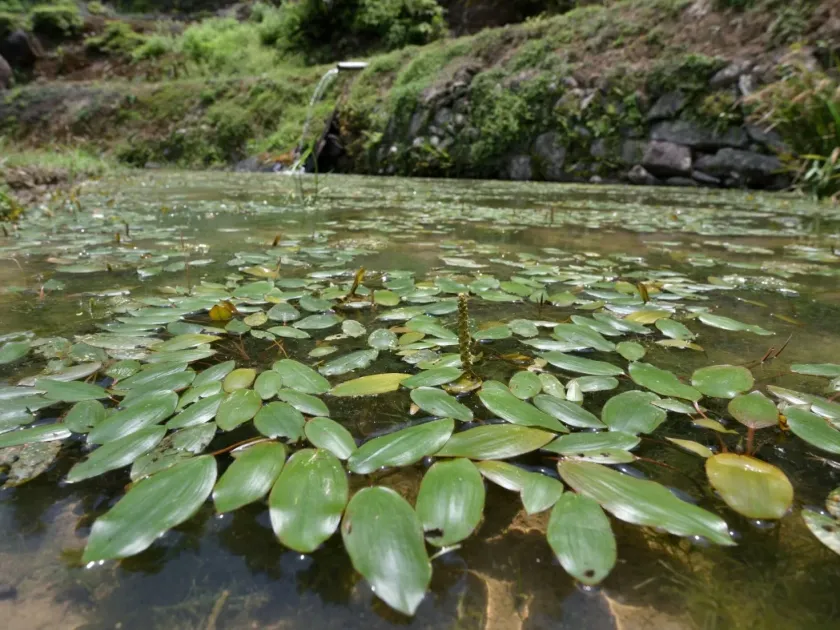
The stems of the plant can reach lengths of one meter or more and can be either submerged or partially floating. A key identifying characteristic is the presence of both submerged and floating leaves.
The submerged leaves are typically lanceolate, narrow, and translucent, borne on long petioles. The floating leaves have a denser, leathery texture and are usually oval or broadly lanceolate in shape.
Flowering occurs during the summer, when spike-like inflorescences emerge above the water surface. The flowers are small, greenish, and arranged in dense cylindrical spikes on upright peduncles.
The seeds possess high germination potential and can remain viable in bottom sediments for several seasons, which complicates the complete eradication of this weed.
Where it grows
Potamogeton distinctus is a typical hydrophyte that prefers stagnant or slow-moving freshwater bodies. In agroecosystems, it poses a significant threat to rice paddies.
It is mainly found in regions with developed rice cultivation, where artificially created flooded field conditions facilitate its active vegetative propagation and colonization.
The plant successfully adapts to various soil types as long as a high moisture level, characteristic of flooded crops, is maintained, making it difficult to eradicate within rice production systems.
The weed spreads via seeds carried by water and through rhizome fragments that are easily transported between fields by agricultural machinery during operations.
Optimal conditions for growth include warm water and high light intensity, which is why its development peaks during the period of intensive rice crop growth.
Harm it causes
The primary damage caused by Potamogeton distinctus is direct competition with rice for nutrients, space, and sunlight, leading to significant yield losses.
Dense mats of this weed obstruct the flow of water in irrigation canals, causing siltation and disrupting the hydrological regime of rice fields.
The plant physically suppresses rice seedlings during early growth stages by intercepting solar energy and inhibiting photosynthesis, which reduces rice tillering.
The weed acts as an intermediate host for several fungal and viral diseases that can be transmitted to crops through the water in high-density vegetation zones.
Infestation of fields makes mechanized harvesting significantly more difficult, as the weed biomass clogs harvester mechanisms and increases the moisture content of the harvested grain.
How to control
Agricultural control methods include deep plowing after harvest, which helps to cut and desiccate rhizomes on the soil surface.
An effective strategy involves crop rotation and temporarily switching rice paddies to dry-land farming, which deprives the weed of its habitat and leads to the decay of its submerged organs.
Chemical control is achieved through the application of systemic herbicides approved for use in rice fields during the active growth phase of the weed.
- Timely clearing of irrigation systems and channels from plant residues.
- Managing water levels in paddies (periodic drainage).
- Using high-quality seed material free from weed seed contamination.
It is crucial to implement integrated control, combining chemical methods with precise leveling of the field surface, as micro-topography irregularities create refuge zones where the weed can escape herbicide application.
Taxonomy
- Latin name
- Potamogeton distinctus
- Family
- Рдестовые
- EPPO code
- PTMDI