
Curly-leaf pondweed
Potamogeton crispus
Description
How to tell it apart
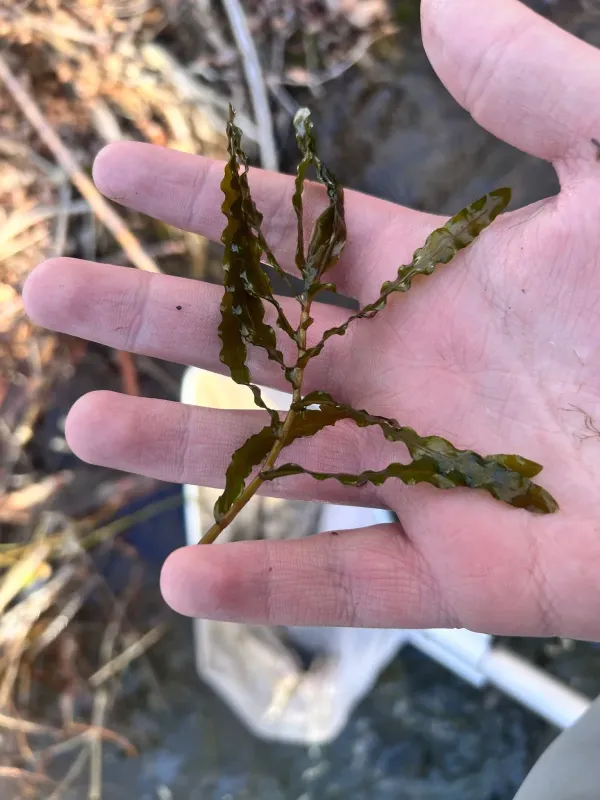
Curly-leaf pondweed is a perennial aquatic plant belonging to the Potamogetonaceae family, easily identified by its crinkled, wavy leaf edges that resemble lasagna noodles.
The stems are flattened and branched, growing from submersed rootstocks that anchor the plant firmly into the sediment of water bodies.
During the spring, the plant develops small, reddish-brown flowers on spikes that rise above the surface of the water for pollination.
A distinctive feature of this species is the production of turions, which are specialized winter buds that allow the plant to survive harsh winter conditions and propagate rapidly.
The leaves are typically green to reddish-brown and exhibit finely serrated margins, which are a critical characteristic for distinguishing it from other pondweed species.
Where it grows
Curly-leaf pondweed thrives in various aquatic environments including lakes, ponds, slow-moving rivers, and man-made irrigation canals.
It prefers nutrient-rich waters and is highly tolerant of low-light conditions, allowing it to begin growth earlier in the season than many native aquatic plants.
In agricultural settings, it frequently colonizes irrigation ditches, where the abundance of nitrates and phosphates promotes rapid biomass accumulation.
The plant has a broad temperature tolerance, which enables it to grow effectively even in cool water temperatures during early spring and late autumn.
It is widely distributed across temperate regions and is considered an invasive species in many parts of the world where it displaces native vegetation.
Harm it causes
The primary concern regarding this weed is its ability to clog irrigation canals, which restricts water flow and causes significant delays in crop irrigation.
Dense mats of curly-leaf pondweed obstruct water intake pipes, interfere with pumping operations, and increase maintenance costs for water infrastructure.
As the plant dies back in early summer, the rapid decomposition of its massive biomass can lead to significant oxygen depletion, threatening aquatic life.
In aquaculture, the presence of this weed hampers fishing efforts and creates unmanageable conditions for breeding and harvesting fish stocks.
It also promotes siltation by slowing down water movement, which leads to the accumulation of organic matter and debris in controlled waterways.
How to control
Mechanical harvesting is a common method for removing large quantities of curly-leaf pondweed from affected irrigation channels and water bodies.
Drawdown procedures, where water levels are lowered to expose the bottom sediment to freezing or drying, are highly effective in killing turions and rootstocks.
Chemical control involving aquatic-approved herbicides requires careful application to minimize impact on water quality and surrounding agricultural crops.
Biocontrol through the introduction of grass carp has proven successful in reducing pondweed biomass in contained areas, providing a sustainable management solution.
- Mechanical removal before the plant forms turions.
- Winter water level management for sediment exposure.
- Nutrient reduction strategies to limit pondweed growth.
- Integrated pest management utilizing multiple control methods.
Taxonomy
- Latin name
- Potamogeton crispus
- Family
- Рдестовые
- EPPO code
- PTMCR