
Lindheimer's beeblossom
Oenothera lindheimeri
Description
How to tell it apart
Lindheimer's beeblossom (Oenothera lindheimeri) is a perennial herbaceous plant belonging to the Onagraceae family. It is characterized by slender, branching stems that can reach heights of up to 1.5 meters.
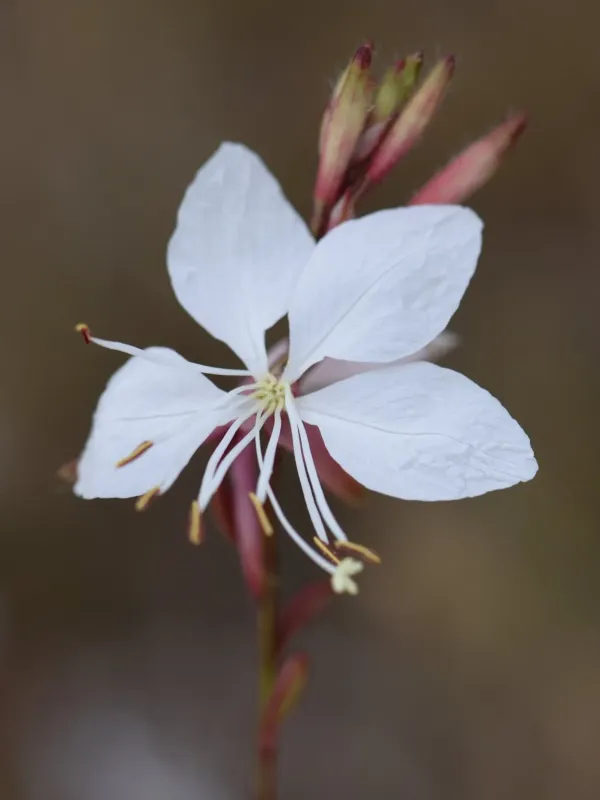
The leaves are lance-shaped, arranged alternately along the stem, and often possess fine hairs. Its flowers, which bloom in long, spike-like racemes, have four petals ranging from white to pinkish hues.
The root system is robust and taprooted, providing the plant with excellent resilience against drought and mechanical disturbances common in agricultural settings.
Seeds are produced in small, four-angled capsules. Due to their small size and lightness, they are highly mobile and can spread rapidly across large areas through wind dispersal.
While often grown as an ornamental, its aggressive growth habit allows it to easily escape cultivation and become a persistent weed in agricultural landscapes.
Where it grows
This species thrives in open, sunny locations with well-drained soils. It is frequently found invading fallow fields, field margins, and neglected pastures.
In agricultural settings, it often encroaches into row crops, orchards, and vineyards, where it can quickly outcompete less vigorous plant species.
Human activity is a primary factor in its spread, as seeds and root fragments are frequently transported via machinery and contaminated soil during field operations.
The plant demonstrates high ecological plasticity, allowing it to adapt to various soil types and thrive in anthropogenic environments where other vegetation might struggle.
Once established in a field, the plant creates dense patches that are difficult to eradicate without sustained management efforts and continuous monitoring.
Harm it causes
The primary damage caused by Lindheimer's beeblossom is its severe competition with crops for water, sunlight, and soil nutrients, leading to significant yield losses.
The plant's dense growth habit causes extensive shading, which stunts the development of young crops and reduces the overall productivity of the field.
Its deep taproot allows it to tap into moisture reserves that are critical for crops during dry spells, effectively intensifying the impact of drought conditions.
The presence of this weed complicates mechanical operations, including harvesting and tillage, often leading to increased equipment wear and operational downtime.
Furthermore, it serves as a host for various agricultural pests and pathogens, providing a refuge that facilitates the re-infection of surrounding crop areas.
How to control
Controlling Lindheimer's beeblossom requires an integrated approach that focuses on exhausting its root reserves and preventing seed bank build-up.
Cultural practices, such as deep tillage, are essential to disrupt the root systems and limit the regeneration potential of established populations.
Chemical control using systemic herbicides, particularly those based on glyphosate, is effective when applied during the vegetative growth phase before flowering begins.
Preventative measures, such as maintaining weed-free field perimeters and cleaning equipment between fields, are critical to limiting its further spread.
- Timely cultivation to prevent seed set and dispersal.
- Use of pre-emergent herbicides in compatible cropping systems.
- Manual removal of young plants, ensuring the entire taproot is extracted.
- Monitoring of headlands and roadsides to identify new infestations early.
Taxonomy
- Latin name
- Oenothera lindheimeri
- Family
- Кипрейные
- EPPO code
- GAALI