
Fireweed
Chamerion angustifolium
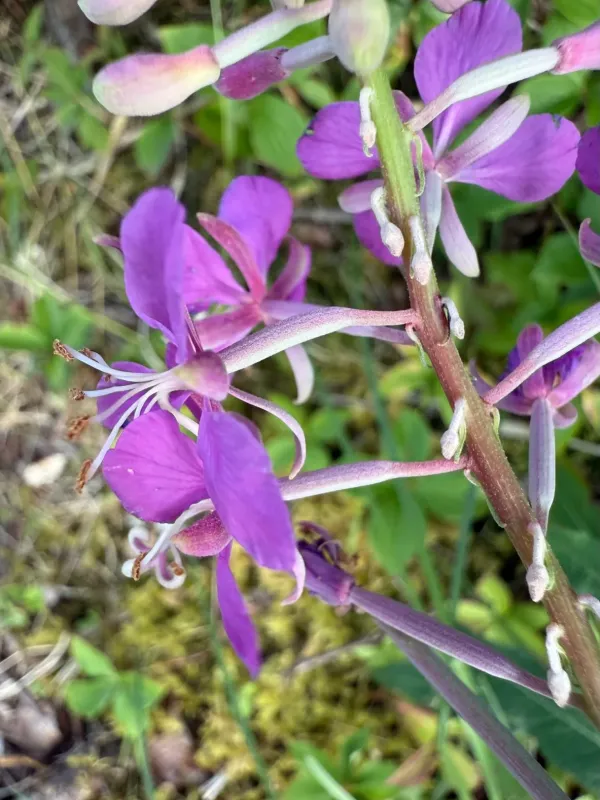
Description
How to tell it apart
Fireweed (Latin: Chamerion angustifolium) is a robust perennial herb belonging to the Onagraceae family. It is characterized by tall, unbranched stems that can grow up to 1.5–2 meters in height, often creating dense stands in disturbed areas.
The leaves are alternate, narrow, and lanceolate, resembling those of a willow tree, which is why it is also known as "willowherb." During the summer months, the plant produces distinctive, large, purple-pink flowers arranged in a long terminal raceme.
One of the most identifying features of fireweed is its root system. It possesses thick, creeping rhizomes that spread underground, allowing the plant to colonize large areas rapidly and regenerate even after being cut down.
The seeds of the fireweed are very small and equipped with fine white hairs, enabling them to be carried by the wind over long distances. This makes fireweed a highly efficient colonizer of new territories, including agricultural field borders.
The plant starts as a small seedling but quickly develops into a perennial with a massive root stock. In agricultural contexts, farmers mostly struggle with the vegetative regrowth of existing perennial roots rather than new seedlings.
Where it grows
Fireweed thrives in open, sunlit environments. In nature, it is a pioneer species that colonizes forest clearings, burned areas, and slopes, but in agriculture, it often invades fields from margins, ditches, and wasteland.
It prefers moist, acidic to neutral soil conditions but exhibits high plasticity, allowing it to adapt to a wide variety of soil types, ranging from sandy loams to peat-rich environments.
Agricultural fields are particularly vulnerable if they border forests or abandoned land. Fireweed seeds can easily travel from these surrounding areas and take root in the field, eventually establishing a persistent presence.
The weed is often found in fields that have been left fallow for a period. Once established, the rhizomes can penetrate deep into the soil, making the plant difficult to eliminate even with conventional tillage practices.
Invasion is often accelerated by mechanical equipment that breaks up the rhizomes during cultivation, inadvertently distributing segments of the root system throughout the field and promoting new growth.
Harm it causes
The primary damage caused by fireweed is intense competition for resources. The plant grows much taller than many grain crops, effectively shading them out and depriving them of vital sunlight, which directly reduces photosynthesis.
Due to its extensive and deep root system, fireweed is a major competitor for soil water and nutrients. In nutrient-poor soils, it can severely stunt the development of neighboring crops, leading to significant yield losses.
Fireweed stems are thick and fibrous, which causes mechanical issues during harvesting. The vegetation can clog the intake systems of harvesting machinery, resulting in increased maintenance costs, downtime, and higher fuel consumption.
It serves as a reservoir for various plant pests and pathogens, including certain fungal diseases that can spread to susceptible crops. This necessitates additional chemical treatments, increasing the overall cost of crop protection.
In forage crops, the presence of fireweed is undesirable because it can decrease the quality and nutritional value of hay or silage, potentially making the harvest less palatable or unsuitable for livestock consumption.
How to control
Managing fireweed requires a strategic, multi-year approach. Since it spreads both by seeds and by vegetative rhizomes, control measures must target both the aerial parts of the plant and the underground storage organs.
Cultural control involves systematic mowing or cutting to exhaust the root system's energy reserves. This must be done consistently before the plant reaches the flowering stage to prevent the production and dispersal of seeds.
Tillage is a common method, but it must be performed carefully. Deep plowing can help, but if the rhizomes are only fragmented and not killed, it can lead to a more severe infestation. Fallow fields should be managed with frequent cultivation to starve the roots.
Chemical control is most effective using systemic herbicides, such as glyphosate, applied during the active growth phase. The chemical must be translocated to the rhizomes to ensure the plant is fully eradicated.
- Regular mowing of field borders and margins.
- Systemic herbicide application during vegetative growth.
- Crop rotation with high-density competitive crops.
- Monitoring surrounding wasteland for seed sources.
Taxonomy
- Latin name
- Chamerion angustifolium
- Family
- Кипрейные
- EPPO code
- CHAAN