
Broad-leaved willowherb
Chamerion latifolium
Description
How to tell it apart
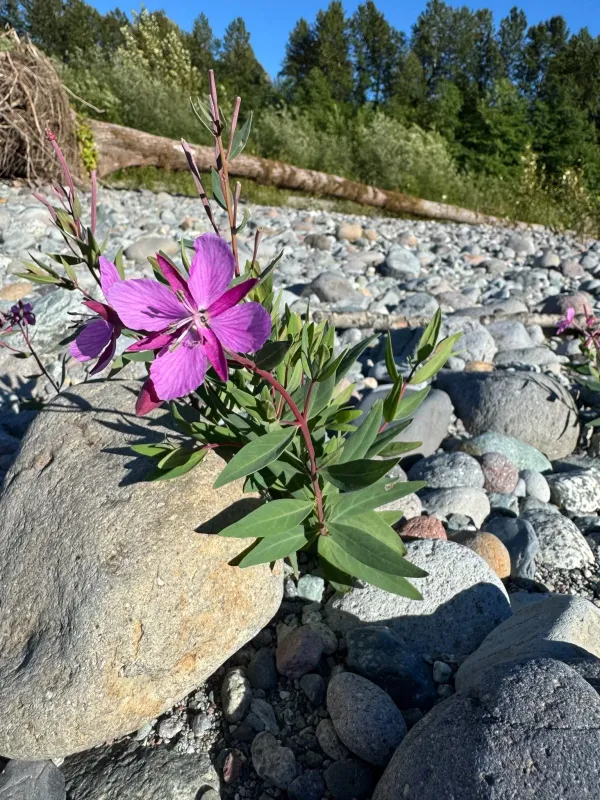
Broad-leaved willowherb (Chamerion latifolium) is a member of the Onagraceae family, growing as a perennial herb with a stout rhizome.
The stems can grow up to 60 cm in height and are typically reddish in color, holding alternate, lanceolate leaves.
Its striking, large, bright pink to purple flowers are arranged in a terminal raceme that blooms during the summer months.
The fruit consists of a long, slender capsule that splits to release numerous seeds equipped with silky tufts for wind dispersal.
It is biologically adapted to thrive in cold climates, demonstrating significant resilience to freezing temperatures and short growing seasons.
Where it grows
This species is widely distributed throughout the Arctic and sub-Arctic regions of the Northern Hemisphere.
It frequently colonizes wet, gravelly areas, riverbanks, and open disturbed grounds near agricultural borders.
The plant demonstrates an aggressive colonization strategy, quickly establishing itself in fields with high moisture content.
It is often found in transition zones between wild tundra landscapes and developed farmland where it acts as an invasive weed.
The plant is highly tolerant of low-nutrient substrates, allowing it to compete effectively in marginal agricultural soils.
Harm it causes
The weed acts as a strong competitor for soil moisture and nutrients, negatively impacting the development of adjacent crops.
Due to its dense growth habit, it can effectively shade out emerging seedlings, leading to reduced stand uniformity.
The extensive root system interferes with standard tillage operations and can damage the efficiency of planting equipment.
Its ability to propagate via wind-dispersed seeds makes it a recurring problem for farmers if not controlled in the early stages.
High infestation levels lead to significant yield losses in feed and grain crops, necessitating intensive management intervention.
How to control
Mechanical control through deep moldboard plowing is essential for uprooting the rhizomes and preventing vegetative spread.
Systemic herbicide applications are recommended during the active growth phase to ensure the chemical reaches the root system.
Implementing a crop rotation scheme that utilizes highly competitive cover crops can suppress the growth of this willowherb.
Mowing before the flowering stage is a critical step to eliminate the production of seeds and prevent future contamination.
Regular field scouting and spot-treatment of emerging clusters help maintain control before the weed becomes widespread.
Taxonomy
- Latin name
- Chamerion latifolium
- Family
- Кипрейные
- EPPO code
- CHALA