
Daurian willowherb
Epilobium davuricum
Description
How to tell it apart
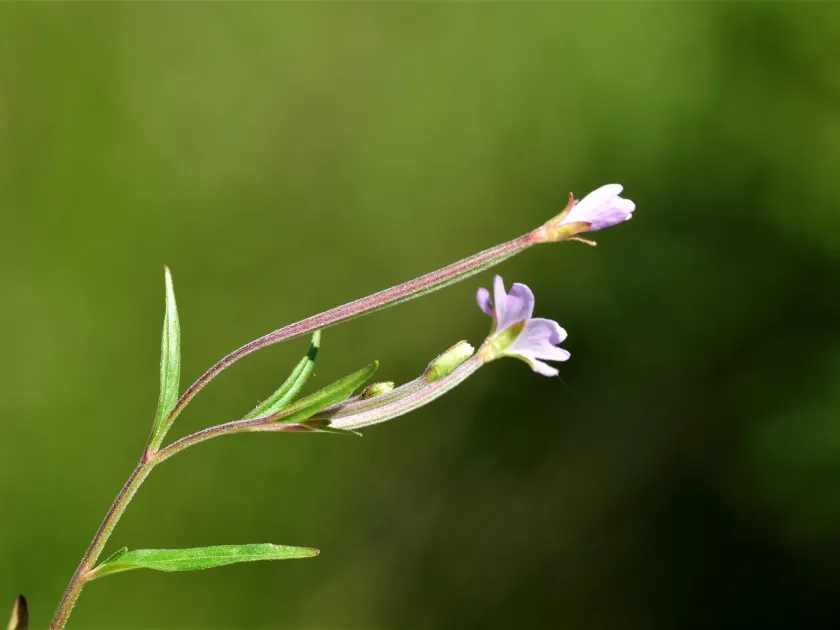
Daurian willowherb (Epilobium davuricum) is a member of the Onagraceae family. It is a perennial herbaceous plant with an upright stem, typically reaching heights between 15 and 50 centimeters.
The key identification feature is its narrow, linear-lanceolate leaves arranged alternately along the stem. In the upper part of the plant, the leaves often become sessile, which helps to distinguish it from related willowherb species.
The flowers are small, colored in shades of pink or lilac-pink, and are arranged in loose inflorescences at the tips of the shoots. Flowering occurs in mid-summer, supporting vigorous seed production.
The root system consists of thin rhizomes capable of forming wintering buds, which allows the plant to survive adverse conditions and regrow reliably in the following season.
Seeds are equipped with tufts of hair, facilitating long-distance dispersal by wind, which makes this species highly invasive in neighboring agricultural fields.
Where it grows
This species prefers habitats with high moisture levels, and it is most commonly found in wetlands, marshy meadows, riverbanks, and along drainage ditches.
In agricultural settings, Daurian willowherb frequently infests crops grown in poorly drained soils or low-lying areas of fields where water accumulates after rain events.
The weed quickly colonizes areas with disturbed soil cover, including field margins and access roads, where it finds minimal competition from other vegetation.
Thanks to its adaptability, the plant successfully thrives in northern climates, maintaining its physiological activity even in challenging soil and temperature conditions.
The presence of Daurian willowherb serves as a biological indicator of excessive soil moisture, signaling a need for better field drainage management.
Harm it causes
The primary damage caused by this weed is its competition with crops for water, mineral nutrients, and solar radiation, leading to reduced overall yield potential.
In infested areas, Daurian willowherb can grow in dense patches that overwhelm cultivated crops, specifically affecting the growth rate and quality of the harvest.
The canopy formed by the weed creates significant shading, which is particularly detrimental to light-dependent agricultural crops during their early developmental stages.
The presence of this weed complicates mechanical field operations, necessitating increased labor and machinery costs for weed removal and post-harvest grain cleaning.
Daurian willowherb may act as a host for various agricultural pests and pathogens, which can subsequently spread to the main crop, necessitating additional protective measures.
How to control
Effective management begins with improving field drainage, as lowering the moisture content makes the environment less favorable for the survival and spread of Daurian willowherb.
A primary agronomic practice involves deep fall plowing with soil inversion, which cuts the rhizomes and exposes them to drying and freezing during the winter.
Systematic inter-row cultivation during the growing season helps to deplete the reserves stored in the plant's rhizomes, gradually suppressing its regrowth capacity.
Chemical control, if necessary, involves the use of systemic herbicides that are absorbed by the foliage and translocated to the roots to ensure complete plant destruction.
- Implementation of clean summer fallow systems.
- Use of high-quality, certified seed to prevent field contamination.
- Crop rotation with vigorous, competitive species to shade out the weed.
Taxonomy
- Latin name
- Epilobium davuricum
- Family
- Кипрейные
- EPPO code
- EPIDA