
Down-flow evening primrose
Oenothera curtiflora
Description
How to tell it apart
The down-flow evening primrose (Oenothera curtiflora), formerly classified as Gaura parviflora, belongs to the Onagraceae family. It is an annual or biennial herbaceous plant with an upright stem that can reach heights of 1 to 1.5 meters.
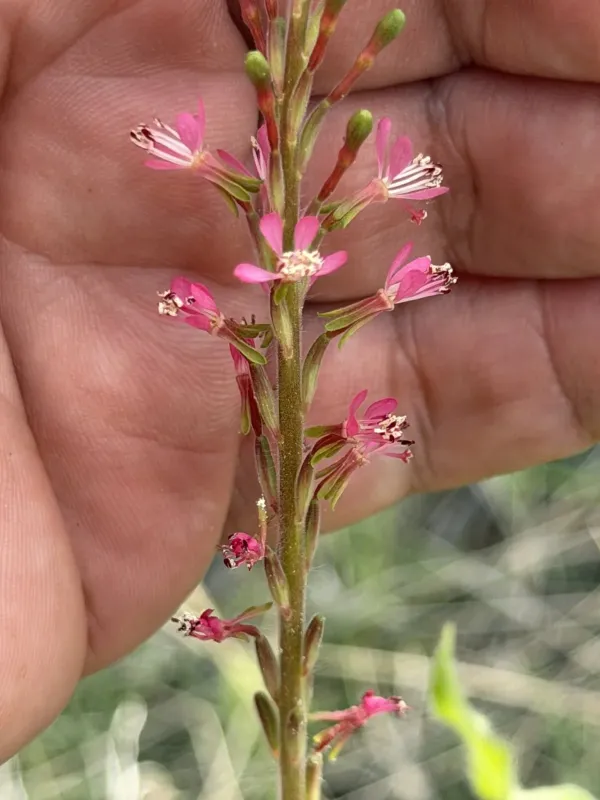
The leaves are arranged alternately and are oblong-lanceolate, often covered with fine, soft hairs that give them a grayish appearance. The primary identifying feature is the small pinkish or white flowers, which are clustered in long, spike-like inflorescences.
Flowering occurs throughout the summer, after which seed capsules containing numerous seeds are formed. The plant has a taproot system that penetrates deeply into the soil, providing high vitality and drought tolerance.
This species is highly capable of self-seeding, which makes it an aggressive colonizer in favorable climates. In the seedling stage, it forms a basal rosette of leaves close to the ground, which can make early identification among other weeds difficult.
It is important to distinguish this species from other primrose varieties by its small flower size and characteristic fruit shape. During the vegetative phase, it is often noticeable by the grayish-green tint of its leaves caused by dense pubescence.
Where it grows
This weed species is native to North America, but its range has expanded significantly to other regions globally over the past few decades. The down-flow evening primrose prefers well-lit areas with loamy or sandy soils.
It is most commonly found on abandoned fields, waste ground, roadsides, and disturbed landscapes. It actively invades agroecosystems, infesting rows of row crops, cereals, and forage grasses.
The plant shows high adaptability to various moisture conditions but prefers open spaces without significant shading. Its ability to quickly colonize available patches makes it a dangerous invasive species in agricultural settings.
In the agricultural sector, the down-flow evening primrose poses a serious threat to fields with low crop density. It survives moderate droughts effectively, allowing it to thrive in environments where other weed species might perish.
Seed dispersal is facilitated by wind, water, and agricultural machinery, which contributes to the rapid spread across large areas. It often colonizes field edges first before gradually encroaching into the main crop area.
Harm it causes
The primary damage caused by this plant is intense competition with crops for vital resources such as water, nutrients, and sunlight. Thanks to its deep taproot, it can extract water from deeper soil layers, depriving adjacent crops.
Massive emergence of Oenothera curtiflora leads to a reduction in crop stand density, which directly impacts final yields. The weed can shade crops, significantly slowing down their growth and development during critical stages.
The weed acts as a reservoir for various pests and pathogens that affect many agricultural crops. The presence of this plant complicates routine crop protection measures and increases overall production costs.
In seed-production fields, the presence of this species is highly undesirable as contamination reduces the quality and purity of the seed lot. This necessitates additional cleaning processes after the harvest is completed.
Furthermore, the stiff stems of the mature weed can interfere with harvesting equipment. This increases the risk of clogging combine headers and other machinery parts, leading to operational downtime and harvest losses.
How to control
Agronomic control methods include thorough tillage during the fall to eliminate young plants before they reach the seeding stage. Regular inter-row cultivation in row crops significantly inhibits the growth of the evening primrose.
Crop rotation is a vital practice to prevent the accumulation of a persistent seed bank in the soil. Using competitive crop varieties that close rows quickly helps limit sunlight availability to the weed seedlings.
Chemical control is effective when using systemic herbicides, particularly during the early vegetative stages. Products based on glyphosate are highly effective when applied to fields in fallow or after the main crop has been harvested.
When using selective herbicides within growing crops, it is crucial to observe the growth stages of both the crop and the weed. Using tank mixtures can enhance efficacy and prevent the development of weed resistance.
- Promoting weed emergence through early harrowing.
- Timely chemical weeding before the flowering stage.
- Rigorous cleaning of seeds to prevent spread.
- Application of soil-applied herbicides for residual control.
- Mowing weeds on non-cropped areas surrounding the field.
Taxonomy
- Latin name
- Oenothera curtiflora
- Family
- Кипрейные
- EPPO code
- GAAPA