

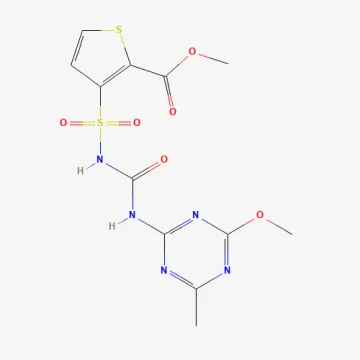
Active ingredient
Especially harmful
Thifensulfuron-methyl
Description
Mode of action
Thifensulfuron-methyl belongs to the sulfonylurea chemical class and acts as a systemic herbicide that is primarily absorbed through the foliage of weeds.
The mode of action involves the inhibition of the acetolactate synthase (ALS) enzyme, which is critical for the synthesis of essential branched-chain amino acids.
Once the enzyme is blocked, the cell division process stops almost immediately, leading to a rapid cessation of weed growth.
Visible symptoms of the herbicide activity include leaf chlorosis and necrosis, which typically develop within a few days after the treatment.
Crop plants possess the ability to metabolize this compound into non-toxic substances, which grants the herbicide its high selectivity and safety for the main crop.
What it targets
This active substance is highly effective in controlling a broad spectrum of annual broad-leaved weeds in various agricultural crops.
Key target weed species include lambsquarters, smartweeds, pigweed, shepherd's purse, and various types of wild mustard and chamomile.
It is specifically designed to eliminate competition from weeds that emerge early in the season, ensuring that the crop can reach its full yield potential.
The product provides robust control against many troublesome species that are difficult to manage with older types of herbicide chemistry.
Regular monitoring of field weed populations is recommended to ensure the herbicide is applied against the most susceptible growth stages.
Rates and timing
Application should ideally occur when the weeds are in the early seedling stage, typically between the 2 and 4-leaf growth phase.
For cereal crops, the treatment is recommended from the start of tillering up until the flag leaf stage, depending on local labeling.
In soybean cultivation, applications are typically made during the early vegetative stages, ensuring the crop is actively growing and not under stress.
The standard dosage ranges from 10 to 50 grams of active substance per hectare, depending on the specific weed spectrum and density on the field.
The use of a high-quality surfactant or adjuvant is strongly recommended to enhance leaf penetration and optimize the herbicidal performance.
Restrictions
Applications should be avoided when the crop is under stress from drought, cold weather, or significant pest pressure, as this can reduce efficacy and increase the risk of injury.
Soil residual activity is relatively low, but crop rotation sequences should still be observed according to regional guidelines and product labels.
To prevent the development of resistant weed biotypes, it is essential to rotate the use of ALS-inhibitor herbicides with products representing different modes of action.
Strict adherence to personal protective equipment guidelines is mandatory during the mixing and application process to ensure operator safety.
Drift management is crucial to avoid unwanted contact with sensitive non-target broad-leaved crops growing in adjacent fields.
Content graph
Connections · Thifensulfuron-methyl
Most often together:
Marketplace
Products · 138


Smit v.g., + PAR York
China Chemical Industrial & Rice Co. Ltd
Herbicides
0
0
·
40
1 offer
239.64 €per 1 l
Buy

Basis 75 WG
«Дюпон Інтернешнл Оперейшнз Сарл», Швейцарія
Herbicides
0
0
·
39
1 offer
764.25 €per 1 l
Buy


Formula
China National Chemical Construction Ningbo Import & Export Co.
Herbicides
0
0
·
37
3 offers
34.4 €per 1 l
Buy

Trivium, VG, Herbicide + PAR Booster
Alpha Smart Agro
Herbicides
0
0
·
36
1 offer
48.25 €per pack
Buy


Batu v.g., (Rimsulfuron 500 g/kg + Tifensulfuron-methyl 250 g/kg)
Сінокем Хебеї Корпорейшн, м.Шийяжуанг, Китай
Herbicides
0
0
·
35
3 offers
118.64 €per 1 l
Buy


Alpha-Mais
«Юнісіті Ентерпрайсіс Л.П.», Единбург, Великобританія
Herbicides
0
0
·
34
1 offer
74.2 €per 1 l
Buy


Tiberius, WG (tifenpyrsulfuron-methyl, 500 g/kg + tribenuron-methyl,
Unicity Enterprises L.P.
Herbicides
0
0
·
33
3 offers
49.44 €per 1 l
Buy


Torino, WG (Tifenosulfuron-methyl, 750 g/kg)
Unicity Enterprises L.P.
Herbicides
0
0
·
32
8 offers
10.29 €per 1 l
Buy

Alpha-Star-Duo
«Юнісіті Ентерпрайсіс Л.П.», Единбург, Великобританія
Herbicides
0
0
·
32
5 offers
35.88 €per 1 l
Buy

BATU V.G., HERBICIDE WITH SURFACTANT "TALANT"
Сінокем Хебеї Корпорейшн, м.Шийяжуанг, Китай
Herbicides
0
0
·
31
1 offer
41.07 €per pack
Buy

GOLD STAR EXTRA
ТОВ «Фабрика агрохімікатів», Черкаси, Україна
Herbicides
0
0
·
30
3 offers
52.36 €per 1 l
Buy


Segment AX
China National Chemical Construction Ningbo Import & Export Co.
Herbicides
0
0
·
28
2 offers
5.72 €per 1 l
Buy

Harmoni 75 WG
«Дюпон Інтернешнл Оперейшнз Сарл», Швейцарія
Herbicides
0
0
·
27
3 offers
342.15 €per 1 l
Buy

Smith, WG (tifenuron-methyl, 750 g/kg)
Nanjing Red Sun
Herbicides
0
0
·
26
1 offer
141.6 €per 1 l
Buy


Centaur, RG ( rimsulfuron, 500 g/kg + tifensulfuron-methyl, 250
Hangzhou Ruijiang Chemical Co., Ltd.
Herbicides
0
0
·
22
4 offers
145.27 €per 1 l
Buy

Harmonik WG
Nanjing No.1 Pesticide Factory of Red Sun Group Co., Ltd.
Herbicides
0
0
·
1.6K
No offers
—
Details

Tifen-S
China National Chemical Construction Ningbo Import & Export Co.
Herbicides
0
0
·
954
No offers
—
Details


Harmonik WG f.g. + PAR «Escort»
Nanjing No.1 Pesticide Factory of Red Sun Group Co., Ltd.
Herbicides
0
0
·
60
No offers
—
Details


Tifen-S WG
China National Chemical Construction Ningbo Import & Export Co.
Herbicides
0
0
·
56
No offers
—
Details


TIFI
Джянгсу Ріпонт Пести сайд Факторі Ко. Лтд., Джянгсу, Китай
Herbicides
0
0
·
54
No offers
—
Details


Byron, w.g., + PAR York
China Chemical Industrial & Rice Co. Ltd
Herbicides
0
0
·
48
No offers
—
Details

Byron, w.g., (Rimsulfuron, 500g/kg + Tifen sulfuron-methyl, 250g/kg)
China Chemical Industrial & Rice Co. Ltd
Herbicides
0
0
·
48
No offers
—
Details