

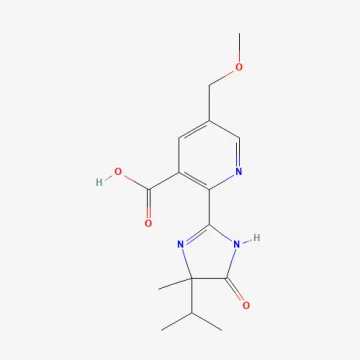
Description
Mode of action
Imazamox belongs to the imidazolinone chemical class and is a highly effective systemic, selective herbicide. The active substance enters the plant primarily through the leaves, but also partially through the root system, after which it rapidly translocates via the xylem and phloem to the growing points.
The mode of action is based on the inhibition of the acetolactate synthase (ALS) enzyme, which plays a key role in the synthesis of essential amino acids: valine, leucine, and isoleucine. Blocking this biochemical pathway leads to an immediate cessation of cell division.
Following the cessation of growth, chlorosis of young leaves, gradual wilting, and necrosis of weed tissues occur. Visual signs of weed suppression appear within a few days, and complete death occurs within two to four weeks, depending on environmental conditions.
Due to its high systemic activity, the substance can effectively affect even weeds that were not directly covered by the spray solution. It remains active within the plant, providing a long residual protection period against new weed emergence.
A distinctive feature of imazamox is its residual soil activity. This allows the product to suppress a second "wave" of weeds that germinate from seeds for some time after the product is applied to the soil.
What it targets
Imazamox is used to control a broad spectrum of broad-leaved and some annual grass weeds. It effectively eliminates species such as pigweed, common lambsquarters, knotweeds, black nightshade, field pennycress, and common ragweed.
The herbicide also shows high activity against problematic weeds such as broomrape. The use of imidazolinones has become the "gold standard" in Clearfield technology for controlling parasitic plants in sunflower fields.
The product suppresses the development of many cruciferous weed species that are difficult to control with other agents. However, the effectiveness of imazamox against perennial rhizomatous weeds, such as thistles or bindweed, may be limited.
To broaden the spectrum of action or increase effectiveness against grass weeds, imazamox is often combined with other herbicides. It is important to consider that weed sensitivity is strongly dependent on their growth stage at the time of application.
- Common lambsquarters (Chenopodium album)
- Pigweed (Amaranthus spp.)
- Black nightshade (Solanum nigrum)
- Sunflower broomrape (Orobanche cumana)
- Knotweeds (Polygonum spp.)
Rates and timing
Imazamox application rates vary depending on the weed species composition, their growth stage, and the crop being grown. Typically, the product is applied during the active growth phase of weeds (from 2 to 4 true leaves for broad-leaved weeds).
For crops with resistance to imidazolinones (e.g., soybean varieties or Clearfield sunflower hybrids), rates ranging from 0.7 to 1.2 liters of product per hectare are used. Higher dosages are required for high weed density or overdeveloped weeds.
The optimal time for application is during morning or evening hours under favorable weather conditions. High air humidity facilitates better leaf absorption, while drought can significantly reduce application efficiency.
It is important to strictly follow the regulations regarding the growth stage of the crop to avoid phytotoxicity. Applying too early or too late can lead to stunted growth of the crop itself, which will negatively affect the final yield.
The spray solution must be prepared immediately before application with thorough agitation. The recommended spray volume is 200–300 liters per hectare to ensure complete wetting of the weed leaf surface.
Restrictions
Imazamox has a long half-life in the soil, which imposes strict restrictions on crop rotation. Growing sensitive crops (e.g., sugar beets, rapeseed, or some cereals) immediately after applying the herbicide can lead to crop failure.
To minimize the risk of residual effects, it is important to perform deep tillage before sowing the subsequent crop. It is also recommended to keep strict records of field history where imidazolinone herbicides were used to avoid accumulation of active ingredients in the soil profile.
It is not recommended to use the product on crops under stress due to frost, excess moisture, drought, or pest damage. Under such conditions, plant metabolism is slowed down, which increases the risk of crop damage.
When working with the product, it is necessary to strictly follow safety measures, using personal protective equipment for skin and respiratory protection. The product is harmful to aquatic organisms, so drift of the spray solution onto water bodies or adjacent areas is unacceptable.
Storage should be carried out in the original packaging in a cool, dry, and ventilated place, preventing access by unauthorized persons and animals. The shelf life is usually 2–3 years, after which the efficiency of the active ingredient may decrease.
Regulatory
Status in the European Union
Approved in the EU
- CAS number
- 114311-32-9
- Category (EU)
- HB - Herbicide
- Approved from
- 01.11.2017
- Approval until
- 30.06.2027
- ADI
- 3.0 mg/kg bw/day
- ARfD
- 3.0 mg/kg bw
- AOEL
- 2.25 mg/kg bw/day
Hazard classification (CLP)
Aquatic Acute 1 - H400Aquatic Chronic 1 - H410
EU status is for reference only and does not replace national registration in your country.
Content graph
Connections · Imazamox
Most often together:
Marketplace
Products · 118


NOPASARAN K.S.
ф.БАСФ СЕ, Німечина на заводі м.Гравелін
Herbicides
0
0
·
101
2 offers
26.38 €per 1 l
Buy


Imidh, RK (imazamox, 40 g/l)
Shandong Cynda Chemical Co., Ltd, КНР
Herbicides
0
0
·
86
4 offers
9.22 €per 1 l
Buy


Takomir, RC (imazamox, 40 g/L)
«Shenyang Sciencreat Chemicals Co., Ltd», Shenyang, Liaoning, Китай
Herbicides
0
0
·
57
3 offers
4.15 €per 1 l
Buy


Euro-3315
Scientific-Production Company "Kvadrat", LLC
Herbicides
0
0
·
55
8 offers
12.34 €per 1 l
Buy


VITALIGHT, RK
ТОВ «Фабрика агрохімікатів», Черкаси, Україна
Herbicides
0
0
·
54
3 offers
11.17 €per 1 l
Buy


Nopasarán, KS (metazachlor, 375 g/l + imazamox, 25 g/l)
BASF Agro B.V.
Herbicides
0
0
·
51
2 offers
26.31 €per 1 l
Buy


Britex 40 RC
Фадер Альянс Лтд., Великобританія (Fader Alliance Ltd., England) на заводах Нідерландів, Польщі
Herbicides
0
0
·
48
4 offers
11.66 €per 1 l
Buy

Madera 48 RC
Фадер Альянс Лтд., Великобританія (Fader Alliance Ltd., England) на заводах Нідерландів, Польщі
Herbicides
0
0
·
48
8 offers
13.9 €per 1 l
Buy


Corum, RK (imazamox, 22.4 g/l + bentazone, 480 g/l)
BASF Agro B.V.
Herbicides
0
0
·
47
10 offers
14.51 €per 1 l
Buy


IMPERIAL, RC
Nantong Pesti Agrochemical Limited Company, Nantong, КНР
Herbicides
0
0
·
45
3 offers
1.43 €per 1 l
Buy


Capreo Protect
Hangzhou Ruijiang Chemical Co., Ltd.
Herbicides
0
0
·
43
2 offers
371.65 €per 1 l
Buy

Genesis, RK
ТОВ «Фабрика агрохімікатів», Черкаси, Україна
Herbicides
0
0
·
43
1 offer
10.36 €per pack
Buy


Clinefekt, WG, herbicide (imazamox, 700 g/kg)
Jiangsu Agricoem Laboratory Co., Ltd.
Herbicides
0
0
·
37
7 offers
0.32 €per 1 l
Buy


Kaptor, RK, (Imazamox, 33 g/l + Imazapir, 15 g/l)
BASF Agro B.V.
Herbicides
0
0
·
36
2 offers
30.95 €per 1 l
Buy


IMI-VIT
ТОВ «Фабрика агрохімікатів», Черкаси, Україна
Herbicides
0
0
·
32
15 offers
7.97 €per 1 l
Buy
