
Mourning dove
Zenaida macroura
Description
How to identify
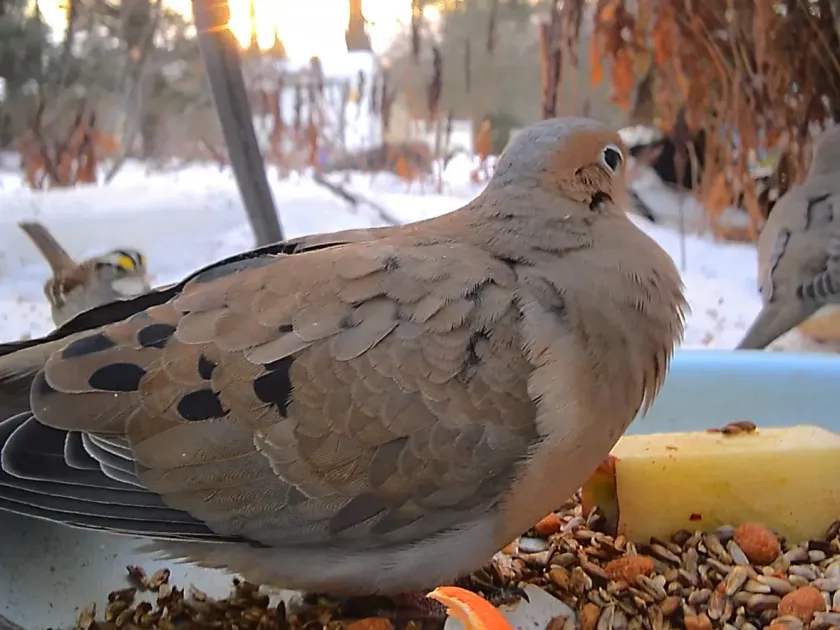
The Mourning Dove (Zenaida macroura) is a member of the Columbidae family, easily recognized by its slender body, long tapered tail, and brownish-gray plumage with characteristic black spots on its wings.
Measuring approximately 30 cm in length, these birds possess a small, dark beak and reddish legs. Their distinct, melancholic cooing sound is a primary identifier, as is the whistling noise their wings make during takeoff.
They are highly adaptable birds found in various open landscapes, including agricultural fields, pastures, and roadsides, where they find ample foraging opportunities for seeds and grains.
Taxonomically, they belong to the order Columbiformes. Despite their status as common birds, their behavior in rural environments often classifies them as significant pests for commercial farmers.
Their ability to thrive in close proximity to human activity and agriculture allows them to maintain large populations that frequently descend upon cultivated fields during critical development stages of crops.
What it damages
Mourning doves cause primary economic damage by consuming seeds during the planting season. They target seeds in the top layer of the soil, often depleting stands before germination can occur.
As crops reach maturity, doves focus on heads of wheat, millet, corn, and sunflowers. They feed on ripening grain, physically knocking it off the plant and causing substantial yield loss per acre.
Fields adjacent to nesting habitats are particularly vulnerable, as high concentrations of doves can result in significant localized damage, thinning crop stands to the point of total failure in certain spots.
In addition to direct consumption, their droppings contaminate the field, which can reduce the quality of the harvested produce and create an environment conducive to plant pathogens.
Furthermore, doves contribute to the spread of invasive weed seeds across agricultural land, necessitating increased herbicide usage and manual weed control to maintain field hygiene.
When it appears
The peak activity of the Mourning Dove on farmlands occurs during the spring sowing period when uncovered seeds are most accessible. This is the most dangerous window for stand establishment.
During the summer, as grains enter the milk-dough stage, the birds aggregate on fields to feed on the nutrient-rich, soft kernels, leading to intensive damage that directly impacts final production volume.
In the autumn, during and after the harvest, doves congregate on stubble fields to forage on grain losses. While this does not directly hurt current yields, it sustains a high local population density.
Because these birds can produce multiple broods per breeding season, their population recovers rapidly, ensuring a constant presence of potential pests throughout the growing season.
While they are present year-round in many regions, their agricultural impact is strictly tied to the phenological stages of the crops they prefer to consume, requiring seasonal surveillance.
Signs of infestation
The most evident signs of Mourning Dove presence are sparse patches or "bald spots" in newly seeded fields, where birds have systematically cleared the ground of sown seeds.
Inspecting crop stalks often reveals stripped or partially eaten heads, especially in wheat and millet, where the lower and middle sections of the grain-bearing parts have been pecked away.
Significant accumulation of fecal matter on the soil surface and plant leaves within specific areas of the field serves as a clear indicator of a feeding site or a roosting zone.
The characteristic cooing sounds and the audible whistling of wings when groups of birds flush from the field are reliable indicators of their active feeding behavior.
Presence of feathers and localized soil disturbance in agricultural clearings confirm that the field is being utilized by the doves as a primary food source, warranting immediate protective measures.
Control measures
Bioacoustic deterrents are highly effective for field protection. These systems broadcast distress calls or raptor sounds, which successfully simulate threats and force the doves to vacate the area.
Visual deterrents, including predatory bird silhouettes, reflective streamers, and holographic ribbons, are useful in confusing the pests and preventing them from settling on the crops.
Deep soil incorporation of seeds during planting is a fundamental preventative measure, as it physically masks the food source from the birds, significantly reducing the success of their foraging.
Propane cannons, which trigger loud, rhythmic reports, serve as one of the most reliable and efficient methods for managing larger agricultural plots against bird predation.
- Utilizing protective netting for specialized or high-value seed crops.
- Ensuring post-harvest field hygiene by collecting stubble and grain losses.
- Maintaining clean field perimeters to eliminate secondary food sources.
Taxonomy
- Latin name
- Zenaida macroura
- Family
- Columbidae
- EPPO code
- ZENDMA
Discussion
No discussions yet — be the first.