
Cape Turtle Dove
Streptopelia capicola
Description
How to identify
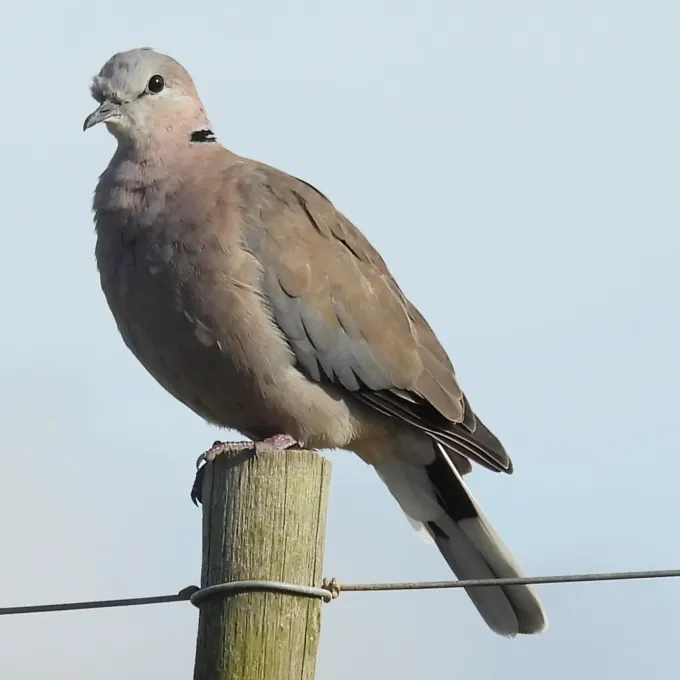
The Cape Turtle Dove (Streptopelia capicola) is a member of the Columbidae family. It is a medium-sized bird, easily recognized by a distinct black collar on the back of its neck.
Its plumage is primarily grayish-brown with lighter underparts and a tail featuring a dark band with white edges. The bird is known for its loud and repetitive call, which makes it easy to locate in agricultural environments.
This species is highly adaptable and thrives in various habitats, including croplands, where it finds abundant food sources and nesting opportunities throughout the year.
The bird's biology allows it to breed multiple times during the year under favorable climatic conditions, leading to stable and often large population densities in farming areas.
These doves are cautious birds, which makes standard scare tactics often ineffective if not managed with frequent variations to prevent habituation.
What it damages
Cape Turtle Doves cause significant damage to grain crops such as millet, sorghum, maize, wheat, and sunflowers. They target both the seeds during planting and the developing heads during maturation.
During the planting season, the birds congregate on fields to forage on uncovered seeds, often leading to patchy crop emergence and the costly necessity of reseeding entire areas.
As the crops reach maturity, the doves swarm the fields to feed on ripening grain. Their weight often breaks the stalks of sunflowers or grain heads, causing the crops to lodge and making harvesting difficult.
Beyond direct grain consumption, the birds contaminate fields with droppings, which reduces the overall quality of the harvested grain and poses health risks if used for animal feed.
- Significant reduction in yields for cereal and oilseed crops.
- Structural damage to plants causing lodging and harvesting issues.
- Financial losses resulting from re-sowing and cleaning costs.
When it appears
The primary period of damage occurs during the sowing season when seeds are vulnerable on the surface, and during the milky-to-dough stages of grain development.
In dry regions, doves tend to cluster around irrigated fields and water sources, where they exert localized but high-intensity feeding pressure on agricultural crops.
Bird activity is closely linked to the crop harvesting calendar in the region, as flocks move quickly to exploit the most accessible and nutrient-rich food sources available at the time.
Winter months may show a shift in bird behavior, but in regions with mild weather, flocks often remain active, feeding on crop residues and weed seeds throughout the dormant season.
Regular monitoring of neighboring farms is essential for farmers, as the movement of dove flocks is highly dependent on regional harvesting patterns and food availability.
Control measures
Acoustic deterrents that play recordings of predator calls or bird alarm signals are commonly used. For best results, these systems should use randomized sound patterns.
Visual aids, such as predator decoys and reflective materials, can serve as a temporary deterrent to protect high-value plots during the most vulnerable crop stages.
Agronomic practices, such as ensuring proper planting depth and using mechanical protection like netting, remain the most reliable methods for protecting seeds from being eaten.
Seed treatments using taste-based repellents can make sown seeds unpalatable to birds, effectively preventing them from foraging on freshly planted fields during the critical germination phase.
An integrated approach combining physical scaring, optimized planting schedules, and effective weed control to reduce secondary food sources is recommended for long-term population management.
Taxonomy
- Latin name
- Streptopelia capicola
- Family
- Columbidae
- EPPO code
- STPECA
Discussion
No discussions yet — be the first.