
Collared dove
Streptopelia decaocto
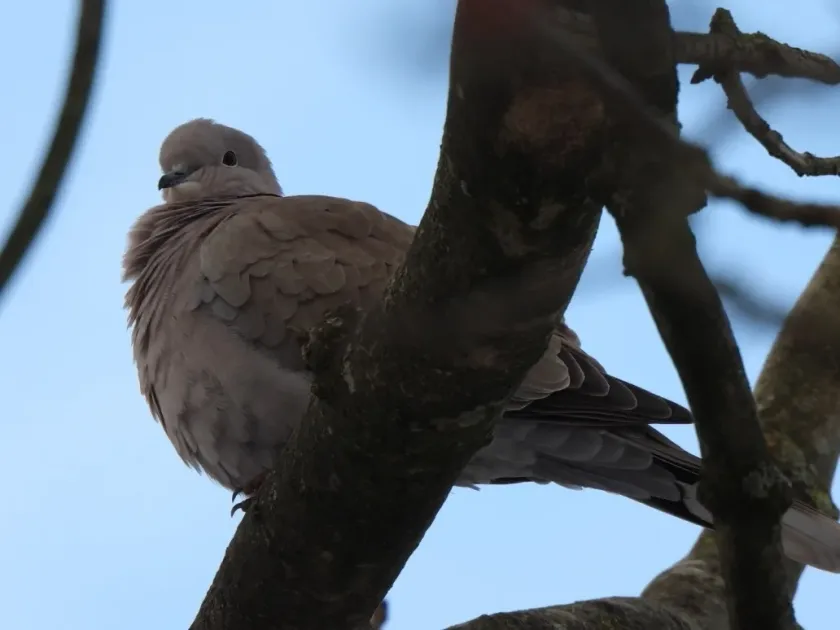
Description
How to identify
The Collared Dove (Streptopelia decaocto) is a member of the Columbidae family, widely recognized for its pale, pinkish-beige plumage and slender build.
Its most distinguishing feature is a narrow, black semi-collar on the nape of its neck, which provides the species with its common name.
These birds are highly adaptable and thrive in both urban and rural environments, often nesting in trees near agricultural production sites.
They are medium-sized birds with powerful flight, allowing them to travel considerable distances from nesting sites to favorable foraging areas in farmland.
Collared doves are sociable birds and often form flocks, especially when foraging, which can lead to localized but intense pressure on crops.
What it damages
Collared doves primarily feed on seeds, causing significant damage to cereal crops such as wheat, barley, maize, and sunflower seeds.
During the planting season, they efficiently locate and dig up newly sown seeds, leading to poor crop establishment and reduced plant density.
As the crops reach maturity, doves congregate in fields to feed on ripening grains, causing direct yield loss through grain removal.
They also cause mechanical damage by trampling young seedlings and breaking stems while attempting to reach food sources on the ground.
In post-harvest environments like grain storage facilities, their presence leads to product contamination with droppings, potentially introducing pathogens.
When it appears
Collared doves are non-migratory and remain in the same region throughout the year, meaning they pose a persistent threat to agricultural activities.
Peak damage usually occurs during the sowing phase when seeds are exposed on the soil surface, making them easy targets for the birds.
Damage intensity increases during the ripening stage of cereal and oilseed crops, coinciding with the peak nutritional needs of the dove population.
After the harvest, they remain active in agricultural landscapes, feeding on waste grain left behind by machinery or stored in outdoor heaps.
Winter months bring them closer to livestock buildings and grain storage areas, where they rely on human-provided feed and agricultural residues.
Signs of infestation
A primary indicator of their activity is the presence of small, conical holes in the soil where they have excavated recently planted seeds.
Visual observations of large groups of birds perched on fences, power lines, or trees surrounding a field are strong indicators of potential damage.
Evidence of grain loss, such as stripped ears of corn or partially consumed wheat heads, suggests that doves have been actively feeding in the area.
The accumulation of bird droppings on equipment, roofs of granaries, or in fields is a clear sign that a colony or flock is frequenting the location.
The distinct and repetitive three-note call of the collared dove in the vicinity of crops signals their presence and potential for localized infestation.
Control measures
Effective bird control involves the use of bioacoustic devices that broadcast distress calls or sounds of raptors to deter doves from specific areas.
Visual deterrents such as holographic tapes, predatory bird silhouettes, or moving decoys can be effective if moved frequently to avoid habituation.
From an agronomic perspective, increasing the seeding depth ensures that grains are less accessible, significantly reducing losses during the sowing stage.
Maintaining clean grain storage sites by sealing gaps and using bird-proof netting prevents doves from accessing stored resources.
Managing weed growth and minimizing grain spillage during harvest helps reduce the attractiveness of agricultural fields to foraging flocks.
Taxonomy
- Latin name
- Streptopelia decaocto
- Family
- Columbidae
- EPPO code
- STPEDE
Discussion
No discussions yet — be the first.