
Spotted dove
Streptopelia chinensis
Description
How to identify
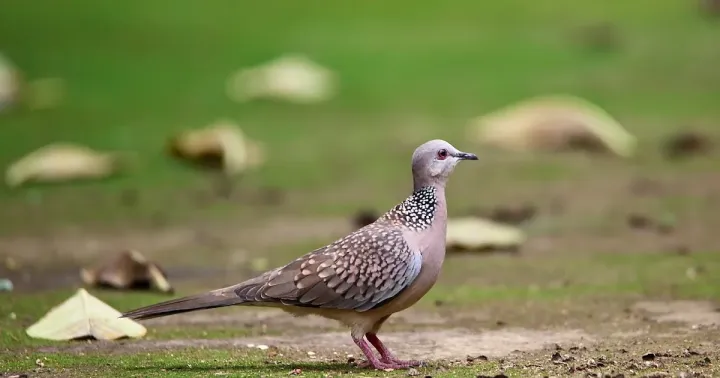
The spotted dove (Streptopelia chinensis) belongs to the order Columbiformes and the family Columbidae. It is characterized by a distinctive white-spotted black collar on its neck, resembling a pearl pattern.
Adults reach a length of about 30 centimeters. The plumage is generally brownish-grey with dark-centered feathers on the back, a light belly, and a tail edged with white.
These birds lead a mostly sedentary or nomadic lifestyle. In agricultural landscapes, they often form small flocks, especially after the harvest season.
Breeding occurs during the warmer months. Nests are built in trees or shrubs, often near human settlements, which provides convenient access to food sources on nearby farms.
High reproductive rates allow the species to quickly colonize new areas that offer a stable food supply and suitable nesting habitats.
What it damages
The primary damage occurs during the sowing phase of grains and vegetables, when birds peck out the sprouting seeds from the soil, significantly thinning the crops.
During the ripening phase, spotted doves feed on rice, wheat, millet, and other cereals. They damage ears of grain, causing seeds to fall to the ground and resulting in harvest losses.
Beyond grains, the pest may destroy vegetable crops by consuming young sprouts and the buds of fruit trees in early spring.
Contamination of fields with bird droppings degrades the sanitary condition of the soil and can facilitate the spread of agricultural pathogens.
Significant economic losses are recorded near nesting sites where bird population density exceeds levels compatible with sustainable crop production.
When it appears
The peak period of activity for this pest occurs in the spring months, coinciding with the sowing season and the emergence of early seedlings.
During the summer and autumn, the threat increases during the milk-wax ripeness phase of grains, when birds migrate en masse to the fields.
In autumn, doves often congregate on harvested fields to scavenge leftover grain, which can interfere with subsequent soil preparation activities.
In winter, due to natural food scarcity, birds may gather near grain storage facilities, causing damage to stored inventory.
The cyclical presence of the pest is directly linked to the phenological stages of plant development and the availability of foraging grounds.
Signs of infestation
Evidence of this pest includes characteristic gaps in crop rows caused by the removal of seeds immediately after sowing.
Tracks and droppings characteristic of Columbidae are frequently found on the soil surface near areas with damaged seedlings.
During ripening, broken stalks and scattered ear remains that have not been fully consumed indicate the presence of feeding flocks.
Observing large groups of birds at field borders during morning and evening hours is a clear sign that they are targeting the crops.
- Seedlings damaged by bill marks.
- Presence of feathers and down within the planting area.
- Scattered grain remains on the surface of the soil.
Control measures
For crop protection, visual deterrents such as reflective tapes, predator effigies, and dynamic whirligigs are used, requiring periodic repositioning.
Acoustic systems that simulate predator cries or distress signals prove highly effective in open field environments.
The use of protective netting is advisable for smaller plots of vegetable crops or berries to physically prevent bird access to the plants.
Agronomic strategies include rapid sowing techniques and the use of seed treatments with repellent properties.
Chemical control measures are strictly regulated by environmental standards and must be applied in accordance with regional agricultural legislation.
Taxonomy
- Latin name
- Streptopelia chinensis
- Family
- Columbidae
- EPPO code
- STPESU
Discussion
No discussions yet — be the first.