
Eared dove
Zenaida auriculata
Description
How to identify
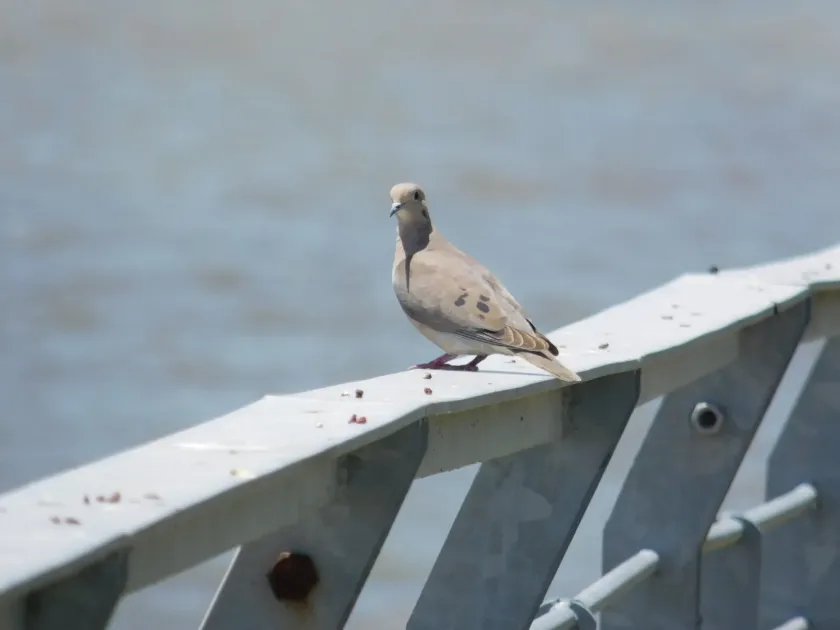
The Eared dove (Zenaida auriculata) is a member of the Columbidae family. It is recognized by the dark, ear-like markings on the sides of its head, from which it derives its common name.
These birds are medium-sized with a grayish-brown plumage that provides effective camouflage in rural and agricultural environments, making them difficult to detect at rest.
They are highly adaptable birds, thriving in various human-altered landscapes. Their ability to survive in agricultural zones has led to a significant increase in their overall population.
Eared doves are gregarious creatures, often seen in large flocks that can quickly overwhelm a field, posing a substantial threat to food security on local farms.
Their reproductive strategy, which allows for multiple broods in a single season, keeps their population numbers consistently high throughout the year.
What it damages
The Eared dove is a notorious agricultural pest, known for causing severe damage to cereal and pulse crops including wheat, corn, sorghum, and sunflowers.
The damage begins shortly after sowing, as the doves dig up and consume seeds from the soil, preventing proper germination and reducing plant density.
Later in the season, the doves feed on ripening grains, causing significant losses during the milk-wax stage when crops are most vulnerable to avian feeding.
Large flocks contribute to crop damage not just through feeding, but also by trampling young sprouts and breaking stems, which reduces the overall yield potential.
Furthermore, the accumulation of bird droppings on the plants and the harvested grain poses health risks and decreases the quality of the agricultural produce.
When it appears
The period of high risk begins during the planting season when fresh seeds are vulnerable to being consumed directly from the seedbed.
The peak of damage occurs during the ripening stage of cereal crops, when the birds aggregate in large flocks to feed on the maturing grain heads.
Since these birds can breed multiple times a year, the pressure on agricultural fields persists across several growth stages, depending on the local climate.
Seasonal migration patterns also influence the timing of their presence, as flocks move between regions in search of the most abundant food sources.
When natural food sources are scarce, the doves rely heavily on commercial farming areas, keeping them active on fields for extended periods.
Signs of infestation
Key signs of infestation include the presence of massive flocks of birds feeding during the early morning or late afternoon hours in agricultural fields.
Visual inspection reveals patches of missing or destroyed crops, often referred to as "bare spots" where birds have successfully cleared the area of seeds or grain.
The presence of bird tracks on the ground, feathers scattered across the field, and significant quantities of feces indicate a high level of bird activity.
Affected crop heads will appear hollowed out or damaged, often showing distinctive bite marks and broken stems where birds have perched to reach the grain.
An increased presence of typical bird vocalizations in the area and a flight pattern of large flocks moving between fields are primary indicators of an established population.
Control measures
Effective management involves the use of bioacoustic devices that broadcast predator calls, which successfully deter flocks from settling on crops.
Visual deterrents, such as raptor decoys, reflective tape, and propane cannons (gas guns), are commonly employed to disrupt the feeding behavior of the birds.
- Deep planting techniques to bury seeds beyond the birds' reach.
- Using protective netting on small-scale farms or experimental plots.
- Systematic monitoring of the fields to identify early arrival of flocks.
Good agricultural practices, such as controlling weeds along fence lines, help to remove potential cover and secondary food sources that attract doves to the area.
Integrated pest management strategies that combine multiple scaring techniques prove most effective in minimizing the economic losses caused by Eared doves.
Taxonomy
- Latin name
- Zenaida auriculata
- Family
- Columbidae
- EPPO code
- ZENAAR
Discussion
No discussions yet — be the first.