
White-winged dove
Zenaida asiatica
Description
How to identify
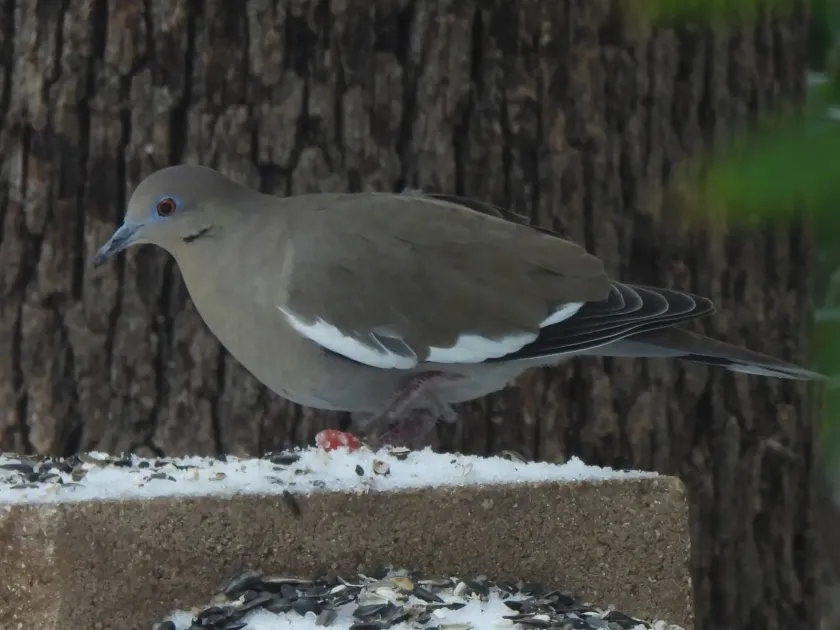
The White-winged dove (Zenaida asiatica) is a member of the Columbidae family. It is easily identified by the white patches on its wings, which are highly visible during flight.
The plumage is primarily grey-brown, providing excellent camouflage. A distinctive blue skin patch around the eyes serves as a key diagnostic feature for field identification.
Adults grow up to 30 centimeters in length and possess a robust bill capable of cracking seeds and feeding on various grains found in open fields.
These birds are highly gregarious and often congregate in large flocks, especially when foraging in agricultural landscapes, making them a significant concern for farmers.
Their characteristic deep, resonant cooing sound is a primary indicator of their presence near crop fields, allowing scouts to track their movements.
What it damages
The White-winged dove causes substantial damage to sorghum, corn, sunflower, and various small grain crops by consuming seeds directly from the soil surface.
Young seedlings are particularly vulnerable, as large flocks can devastate entire field sections within a short period, leading to the need for costly reseeding.
In addition to feeding on seeds, they damage standing crops by knocking grains out of the heads during the ripening stage, leading to significant yield losses.
Fruit orchards also experience damage as these doves peck at ripening fruits, rendering them unmarketable and susceptible to rot and secondary fungal infections.
The accumulation of bird droppings on crops can degrade the quality of harvested grains, leading to potential rejection at grain processing facilities.
When it appears
Feeding activity is highly correlated with the phenological stages of crops, with the highest risk occurring during the sowing season when seeds are exposed.
The ripening phase of grain and oilseed crops represents a peak danger period, as these birds seek high-energy food sources to sustain their metabolic needs.
Seasonal migration patterns play a crucial role in local population density, with increased activity observed during spring nesting and late summer foraging.
Daily activity typically involves early morning and late afternoon foraging flights, which are the optimal windows for implementing bird deterrent strategies.
Late summer months often see an increase in flock size as offspring join adults, leading to larger, more persistent foraging groups in sunflower and corn fields.
Signs of infestation
Signs of infestation include patchy stands where seedlings have been pulled or eaten, along with trampled areas within the field boundaries.
Feathers, eggshell fragments, and heavy accumulation of droppings near field edges or perching spots are clear indicators of a established foraging site.
Cereal heads often show specific pecking marks, or may be found empty if the flock has been feeding on the field for an extended duration.
Regular visual sighting of flocks moving between roosting and foraging sites is a primary sign that proactive management is immediately required.
In orchards, damaged fruit exhibiting dark, sunken holes with signs of fermentation is a classic indication of dove foraging activity.
Control measures
Acoustic deterrents, such as propane cannons and bio-acoustic devices that broadcast alarm calls, are standard and effective methods for protecting large crop areas.
- Installing reflective tapes and holographic spinners to disturb the birds.
- Applying non-toxic seed treatments or repellents to reduce palatability.
- Implementing deep-tillage seeding to minimize seed exposure on the surface.
- Conducting early harvests whenever possible to shorten the duration of vulnerability.
- Using exclusionary netting on high-value fruit and berry plots.
Maintaining a weed-free environment in and around the field reduces alternative food sources, making the site less attractive for the doves to land.
Monitoring the flight paths and identifying roosting locations can allow farmers to target their deterrent efforts more efficiently and effectively.
Combining visual scarecrows with variable acoustic signals prevents habituation, ensuring that the White-winged dove remains a managed risk rather than a disaster.
Taxonomy
- Latin name
- Zenaida asiatica
- Family
- Columbidae
- EPPO code
- ZENAAM
Discussion
No discussions yet — be the first.