
Zelus peregrinus
Zelus peregrinus
Description
How to identify
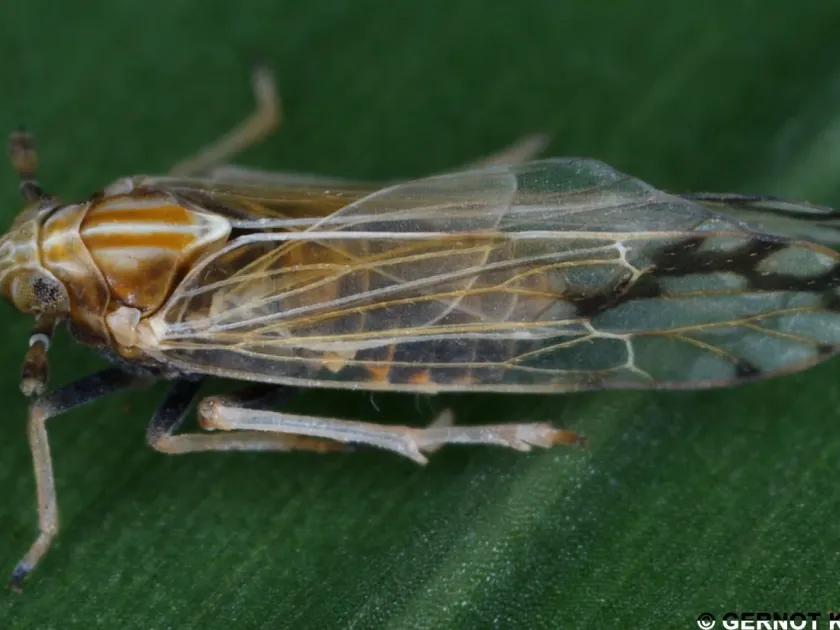
Zelus peregrinus, commonly known as a type of assassin bug, belongs to the family Reduviidae, order Hemiptera. Adult individuals possess an elongated body, typically colored in yellowish or brownish tones, which aids in camouflage within vegetation.
The pest's head is equipped with a developed proboscis, which is tucked under the thorax when at rest. Its legs are slender and long, adapted for agile movement along plant stems.
Nymphs resemble the adults morphologically but differ in smaller size and the absence of fully developed wings. They pass through several instars, gradually increasing in size.
A distinctive feature of the species includes long hairs on the body and limbs, as well as a specific shape of the pronotum. Coloration may vary depending on the habitat and the insect's age.
This species is characterized by high mobility, which complicates the monitoring of its population density across large agricultural areas.
What it damages
Although many assassin bugs are considered beneficial entomophages, Zelus peregrinus can occasionally exhibit phytophagous behavior, causing indirect or direct harm to agricultural crops.
The pest affects a wide range of cultures, including fruit trees, berry bushes, and certain vegetable plants, by sucking sap from young shoots and leaves.
The primary damage consists of disrupting the plant's physiological processes, leading to stunted growth, leaf deformation, and reduced overall crop yields.
Damaged tissues become entry points for secondary infections, including fungal and bacterial diseases, which are transmitted by the bug while piercing the plant tissue.
The pest poses the greatest danger to nurseries and young seedlings, where damage to terminal growth points is critical for plant development.
When it appears
The activity of Zelus peregrinus is directly dependent on temperature conditions, beginning with the establishment of sustained warm temperatures in the spring.
Mass reproduction and peak damage levels usually occur during the summer months, when active vegetation of cultivated plants is observed.
The insect's life cycle includes the egg stage, five nymphal instars, and the adult stage, allowing the species to produce multiple generations within one growing season.
The pests primarily overwinter in the adult stage within plant debris, under tree bark, or in the surface layer of soil protected from freezing temperatures.
With the onset of autumn, activity decreases, and the insects begin searching for overwintering sites, making this period ineffective for active chemical control measures.
Signs of infestation
Signs of the pest's presence include chlorotic spots on leaves, which eventually turn into necrotic areas due to the toxic properties of the insect's saliva.
Upon careful inspection of the underside of leaves, one can discover the individuals themselves or characteristic egg clusters, often attached to stems or petioles.
Curling and deformation of young leaves are often accompanied by the presence of sticky excrement on the plant surface, which attracts ants.
In cases of mass infestation, premature shedding of flowers and fruit sets is observed, which directly impacts the volume of the upcoming harvest.
An indirect sign is the presence of individuals with the characteristic morphological structure, which quickly hide when the plant is disturbed.
Control measures
To control the population of Zelus peregrinus, regular mowing of weeds around fields and orchards is recommended, as these areas serve as reservoirs for the pest.
The application of biological control methods, such as using natural predators or entomopathogenic fungi, shows high effectiveness in greenhouses and indoor environments.
In industrial fruit production, when the damage threshold is exceeded, the use of selective insecticides that are safe for beneficial insect fauna is advisable.
An important element is the adherence to good agricultural practices aimed at maintaining overall plant immunity, including balanced nutrition and proper irrigation.
- Regular monitoring using traps
- Timely removal of plant debris
- Adherence to crop rotation
Taxonomy
- Latin name
- Zelus peregrinus
- Order
- Hemiptera (bugs, aphids, leafhoppers)
- Family
- Reduviidae
- EPPO code
- ZELUPE
Discussion
No discussions yet — be the first.