

Pest · Lepidoptera (butterflies)
Bird cherry ermine moth
Yponomeuta cagnagella
Description
How to identify
The Bird cherry ermine moth (Yponomeuta cagnagella) is a small moth belonging to the family Yponomeutidae, known for its distinctive appearance.
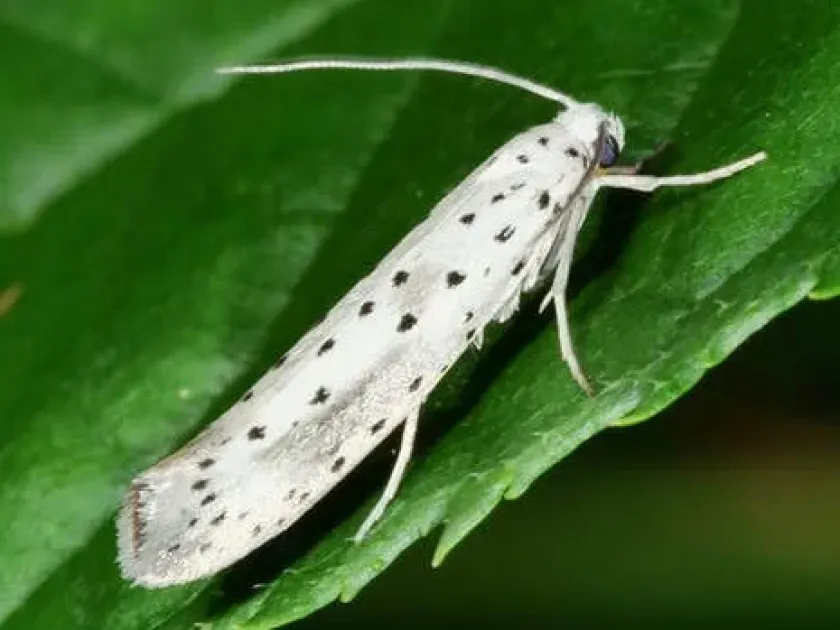
Adult moths have a wingspan of approximately 20–25 mm. Their forewings are white with several rows of conspicuous black dots.
The larvae are yellowish-green with rows of black spots along their sides and possess a dark head, reaching up to 20 mm in length.
The life cycle consists of a single generation per year, with the species overwintering as first-instar larvae protected by a silken shield.
They are colonial insects, which means they live in groups and construct large communal silk webs that protect them during their development.
What it damages
The primary host plant is the bird cherry (Prunus padus), although the larvae can sometimes infest other related woody plants in the Rosaceae family.
The caterpillars are foliage feeders that skeletonize leaves and can cause complete defoliation if the infestation is severe enough.
The loss of foliage weakens the tree significantly, disrupting photosynthesis and reducing its overall growth and vitality for the season.
Young trees are particularly vulnerable, as repeated defoliation can lead to stunted growth and increased susceptibility to other pathogens.
Large colonies can envelop entire branches, covering them in silk and making the plant appear as if it is wrapped in an unsightly web.
When it appears
Overwintered larvae emerge from their protective shields in early spring, precisely when the host tree buds begin to open.
The larvae feed intensively throughout May and June, expanding their silk nests to encompass more leaves as they grow in size.
Pupation occurs within these silk webs, where the larvae gather in clusters to transform into moths during the mid-summer period.
Adult moths emerge in July and August, at which point they mate and deposit eggs on the bark of twigs for the next generation.
These eggs hatch later in the summer, and the new larvae create their overwintering shields, remaining dormant until the following spring.
Signs of infestation
The most prominent sign of infestation is the appearance of dense, white silken webs draped over the branches of the host trees.
Within these nests, you can observe mass clusters of caterpillars actively devouring the green tissue of the leaves.
Affected leaves begin to yellow, wither, and eventually turn brown, creating a patchy appearance on the tree canopy.
In cases of heavy infestation, the entire tree can be covered in silk, obscuring the branches and leaves from view.
Fecal pellets (frass) produced by the caterpillars often accumulate within the silk webbing or at the base of the tree branches.
Control measures
Manual removal of the silk nests is the simplest and most effective control method for small garden trees before the caterpillars pupate.
Chemical control, if necessary, should be applied early in the spring when the larvae are small and before they have caused extensive damage.
Biological pesticides, specifically those containing Bacillus thuringiensis, are highly effective against these larvae while being safe for pollinators.
Encouraging natural predators, such as parasitic wasps and predatory beetles, can help maintain the moth population at manageable levels.
- Regular inspection of trees in late spring to identify early web formation.
- Pruning and destroying heavily infested branches to reduce the pest population.
- Maintaining tree vigor through proper watering and soil fertilization.
Content graph
Connections · Bird cherry ermine moth
Most often together:
Marketplace
Products · 2

Biology
Taxonomy
- Latin name
- Yponomeuta cagnagella
- Order
- Lepidoptera (butterflies)
- Family
- Yponomeutidae
- EPPO code
- HYPNCO
Community
Discussion
No discussions yet — be the first.