
Apple fruit moth
Argyresthia conjugella
Description
How to identify
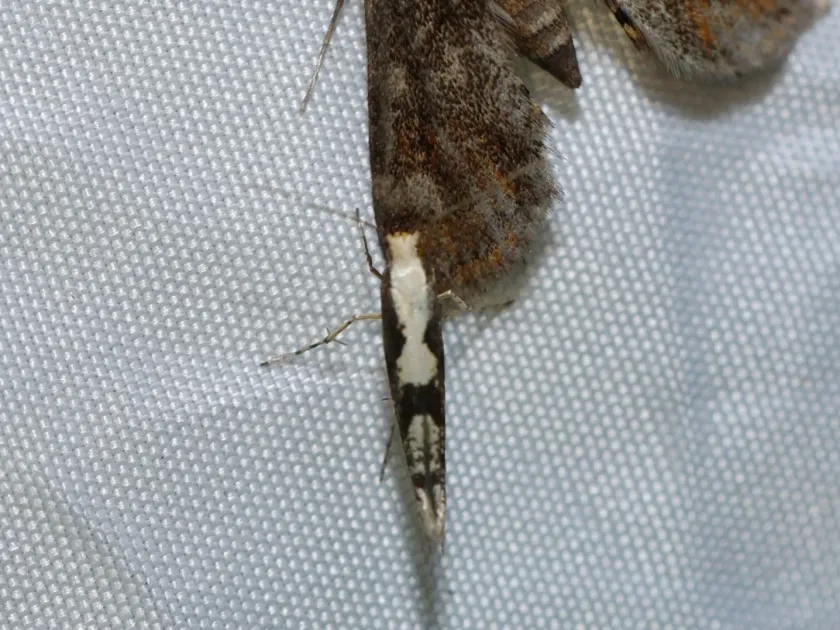
The apple fruit moth (Argyresthia conjugella) is a small moth belonging to the Yponomeutidae family. It has a wingspan of approximately 12–14 mm, with forewings featuring a distinctive pattern of yellowish-brown and white stripes.
The larva of this pest is a small caterpillar, typically reaching up to 7–9 mm in length. Its body color ranges from pale yellow to a deep, striking red, while its head is consistently dark brown or black, serving as a key identification mark.
Taxonomically, it is classified within the order Lepidoptera. This moth is a specialized pest whose lifecycle is strictly synchronized with the phenology of its primary host plants, specifically rowan and apple trees.
Adult moths are nocturnal or crepuscular. During the day, they remain stationary, often resting in the lower, shaded parts of the tree canopy, which makes them difficult to observe during routine garden inspections.
The moth overwinters in the pupal stage, encased in a dense, grey silk cocoon. These pupae typically reside in the upper layers of the soil within the tree's root zone, awaiting favorable temperatures in the spring.
What it damages
The primary host for this pest is the mountain ash (rowan), but when rowan berry crops fail, the moths shift their focus to commercial apple orchards, causing significant economic damage to the fruit.
Larvae bore directly into the fruit, creating complex, winding tunnels inside the flesh. This activity leads to the fruit prematurely dropping from the tree, rendering the harvest unsellable and unfit for storage.
Infested apples undergo rapid decay as the larval tunnels become filled with frass, which promotes secondary fungal infections and significantly reduces the overall quality and shelf life of the remaining yield.
In orchards located near woodlands or areas with abundant rowan populations, infestation rates can be catastrophic, with reports of up to 90% fruit loss in seasons when natural food sources are scarce.
While apple and rowan are the preferred hosts, the moth can occasionally affect other species within the Rosaceae family, though these are typically secondary hosts compared to the primary ones.
When it appears
The flight period of adult moths typically begins during the flowering stage of rowan trees, which often coincides with the late bloom or petal-fall stage of apple trees. This is when females begin laying eggs on the fruitlets.
The larval development stage inside the fruit lasts approximately 30 to 40 days. Once fully grown, usually by mid-summer (July), the caterpillars exit the fruit to pupate in the soil.
The species has one generation per year. The winter is spent as a pupa, and the emergence of the next generation of adults depends heavily on regional climatic conditions and soil temperature.
Environmental factors, particularly humidity and temperature, play a crucial role in the moth's population dynamics. Warm, dry weather usually favors higher survival rates and more intensive reproduction.
Agronomists use the flowering of rowan as a phenological bio-indicator to predict the onset of the moth's activity, allowing for the precise timing of pest monitoring and control interventions.
Signs of infestation
The first external sign of infestation is the appearance of tiny dark entry holes on the surface of developing fruitlets, often surrounded by a faint discoloration or indentation on the fruit's skin.
Inside the fruit, the damage manifests as distinct brown, winding tunnels that often extend towards the core. These tunnels are filled with the larva's dark excrement, which is a telltale sign of the moth's presence.
Premature yellowing and dropping of young apples during the summer months is a common indicator of significant infestation, suggesting that the fruit's vascular system has been compromised by larval feeding.
Occasionally, fine webbing may be visible on the surface of the fruit near the entry point, indicating that the caterpillar is active and has recently entered or exited the apple.
In cases of severe infestation, affected apples become deformed, stunted, and quickly rot on the branches, making the trees appear clearly unhealthy and unproductive during the late summer.
Control measures
Cultural control methods include deep autumn plowing or tilling of the soil around the tree trunks, which exposes the pupae to freezing temperatures and natural predators, significantly reducing the overwintering population.
Strict sanitation practices, such as the daily collection and disposal of fallen fruit, are essential. This prevents the larvae from exiting the fruit to enter the soil for pupation, effectively breaking the lifecycle.
Chemical control should be targeted at the period when young larvae are emerging and before they bore into the fruit. Once they are inside the flesh, insecticides become largely ineffective.
Biological control, using Bacillus thuringiensis-based products, offers an environmentally friendly alternative, particularly effective when applied during the early stages of larval development.
Promoting biodiversity by encouraging natural predators, such as insectivorous birds and parasitic wasps, can provide long-term sustainable control and reduce the necessity for broad-spectrum pesticide applications.
Taxonomy
- Latin name
- Argyresthia conjugella
- Order
- Lepidoptera (butterflies)
- Family
- Yponomeutidae
- EPPO code
- ARGYCO
Discussion
No discussions yet — be the first.