

Pest · Lepidoptera (butterflies) · affects Ornamental crops, Onion, Fodder beet
Especially harmful
Apple ermine moth
Yponomeuta malinella
Description
How to identify
The apple ermine moth (Yponomeuta malinella) is a moth species belonging to the Yponomeutidae family, known for causing significant damage in apple orchards.
Adult moths have a wingspan of approximately 20 millimeters. Their forewings are white with distinct black spots, resembling an ermine fur coat.
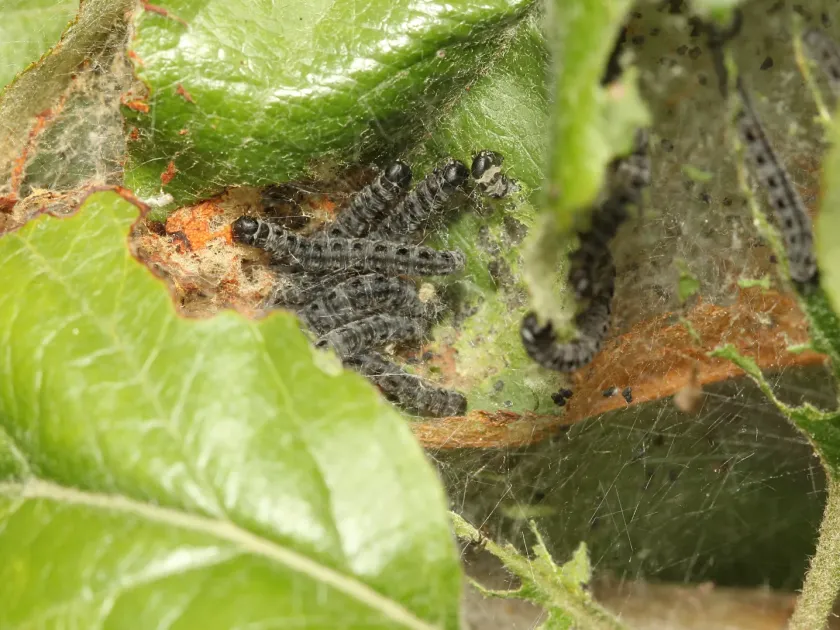
Larvae are yellow-grey with black spots along their bodies. They live in social groups within large, dense silk webs spun across branches and leaves.
The species overwinter as first-instar larvae under a protective shield formed by the female's dried secretions on the bark of twigs.
Pupation occurs within white, spindle-shaped silk cocoons, which are typically found clustered together inside the communal nests built by the larvae.
What it damages
The primary host is the apple tree. In cases of severe infestation, the pest can cause massive defoliation, which severely stresses the tree.
Young larvae initially mine the leaves, while older larvae consume the entire leaf tissue, leaving only the veins intact, which is known as skeletonization.
The loss of foliage leads to a drastic reduction in photosynthesis, preventing the tree from storing enough energy for fruit production or winter survival.
Repeated yearly infestations significantly reduce the crop yield and can lead to the death of branches or, in extreme cases, the entire tree.
The presence of dense webbing also affects the aesthetic value of the trees and creates an environment where other secondary pests or diseases may thrive.
When it appears
The apple ermine moth completes one generation per year. Adult moths typically emerge and fly from late June to August.
Eggs are laid in batches on the bark of young twigs. After hatching, the tiny larvae remain dormant under a protective shield through the winter.
Larval emergence begins in the spring, coinciding with the tree's bud burst and green tip stage, when they start feeding on the tender tissues.
The most active feeding period and the visible formation of silk webs occur throughout the late spring and early summer months.
Pupation takes place in June and July. After a short pupal stage, the adults emerge to mate and lay eggs, starting the cycle anew.
Signs of infestation
Early symptoms include small brown mines on young leaves in the spring, which are caused by the larvae feeding inside the leaf tissue.
The most prominent sign is the appearance of large, conspicuous silk nests or "tents" covering entire branches of the apple tree.
Defoliated branches that look like they have been stripped bare, with only brown, skeletonized leaf remnants, indicate a heavy larval presence.
Small, inconspicuous oval shields on the bark of branches are signs of the overwintering larvae, often difficult to spot without close inspection.
Large colonies of larvae resting or moving within the white webbing are unmistakable signs of an active infestation during the vegetative season.
Control measures
The most effective mechanical control is to physically remove and destroy the silk nests by pruning the affected branches before the larvae pupate.
Chemical control should be timed correctly, targeting the early larval stages as soon as they emerge from their winter shields in the spring.
Biological control using formulations based on Bacillus thuringiensis is highly effective and environmentally friendly, especially in home orchards.
Monitoring adult populations with pheromone traps helps orchardists determine the peak flight periods and the best timing for insecticide applications.
- Pruning and destroying webbed nests by hand.
- Applying insecticides at the green tip stage.
- Encouraging natural predators like parasitic wasps.
- Using biorational pesticides during the growing season.
- Monitoring with pheromone traps for timing accuracy.
Reference
Connections · Apple ermine moth
Most often together:
Marketplace
Products · 1
Biology
Taxonomy
- Latin name
- Yponomeuta malinella
- Order
- Lepidoptera (butterflies)
- Family
- Yponomeutidae
- EPPO code
- HYPNMA
Community
Discussion
No discussions yet — be the first.