
Birch golden moth
Argyresthia brockeella
Description
How to identify
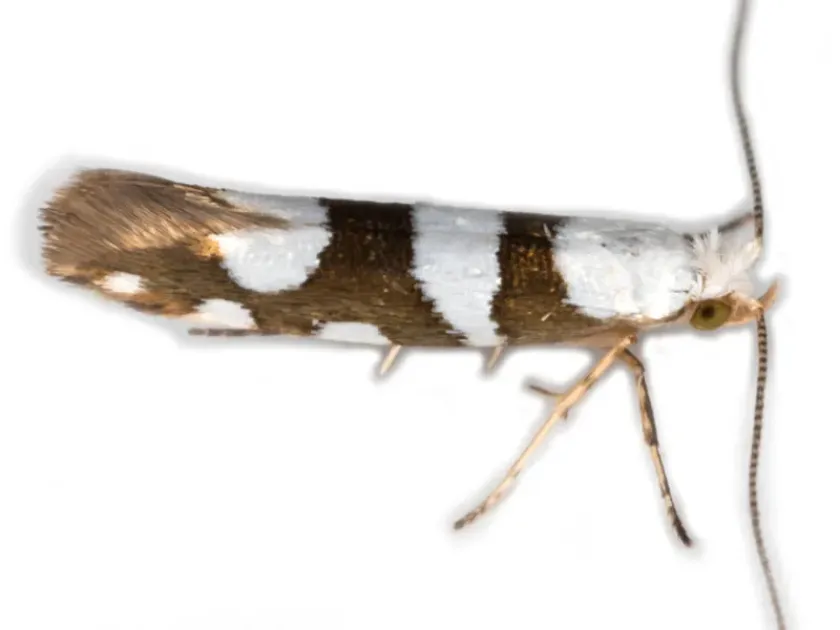
The Birch golden moth (Argyresthia brockeella) is a small lepidopteran belonging to the Yponomeutidae family, known for its distinct metallic appearance.
Adult moths have a wingspan ranging from 10 to 12 mm, making them relatively inconspicuous in natural forest environments.
The forewings are characterized by a golden-yellow to copper metallic sheen, decorated with irregular white transverse bands.
The hindwings are narrow, pale gray, and fringed with long hairs, which is a structural hallmark of the Argyresthia genus.
Larvae are small, yellowish-white with dark head capsules, typically developing within the protective tissues of birch catkins or shoots.
What it damages
The primary host for this pest is the birch tree (Betula species), where larvae feed on reproductive and vegetative tissues.
Damage to developing catkins significantly impacts the seed production of birch stands, which can disrupt natural regeneration in forest ecosystems.
Feeding within apical buds and shoots leads to stunted growth and causes the deformity of emerging leaves during the spring season.
In ornamental settings, severe infestations reduce the aesthetic value of the trees due to leaf chlorosis and premature shedding of damaged parts.
While the moth rarely kills mature trees, repeated damage weakens the host, making it susceptible to secondary environmental stresses.
When it appears
Adult moths are generally active during the summer months, typically appearing between June and July depending on the local climate.
The species overwinters as young larvae, which spend the cold months sheltered within the bark or inside the buds of the host tree.
Activity resumes in early spring, when overwintering larvae emerge to feed on the nutrient-rich tissues of bursting buds.
Pupation occurs in late spring or early summer, with the larvae spinning white, silk-like cocoons on branches or in bark crevices.
The life cycle is univoltine, meaning there is only one generation produced per year, with the larval stage being the most destructive phase.
Signs of infestation
The most visible sign of infestation is the failure of buds to develop properly, often resulting in deformed or withered growth.
Premature browning and drop of catkins are key indicators of larval activity within the reproductive structures of the tree.
Small entry holes on buds and the presence of fine frass near the damage sites suggest active feeding by the moth larvae.
Distorted or curled shoot tips are common symptoms caused by larval burrowing inside the young woody tissues of the birch.
The presence of white, spindle-shaped cocoons attached to twigs or bark during the early summer confirms the presence of the pest.
Control measures
Chemical control involving systemic insecticides is most effective when applied during the bud-burst stage to target early larval activity.
Sanitation practices, including the pruning and disposal of infested twigs during the dormant season, help reduce the overwintering population.
Integrated Pest Management (IPM) focuses on conserving native parasitoid wasps that act as natural biological regulators of the moth population.
Pheromone-based monitoring traps should be utilized to time the applications of control measures accurately and reduce unnecessary pesticide use.
Maintaining tree vigor through proper irrigation and soil care ensures that birch trees can recover effectively from minor infestation events.
Taxonomy
- Latin name
- Argyresthia brockeella
- Order
- Lepidoptera (butterflies)
- Family
- Yponomeutidae
- EPPO code
- ARGYBR
Discussion
No discussions yet — be the first.