
Argyresthia
Argyresthia
Description
How to identify
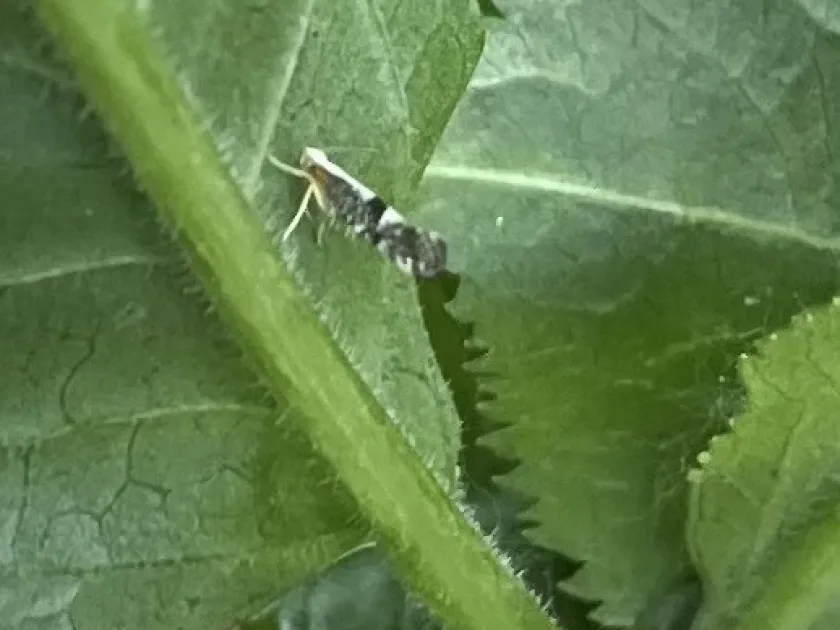
Argyresthia, commonly known as the ermine moth or needle miner, belongs to the family Argyresthiidae. These are small, delicate moths with a wingspan of approximately 10 to 14 millimeters.
The adult moths have narrow wings, often displaying silver, white, or golden patterns. When resting, they hold their wings tightly against their bodies, effectively camouflaging them against tree bark or needles.
The larvae are typically pale green or pink with a dark, sclerotized head capsule. They are well-known as internal feeders, mining into leaves, needles, or buds to consume plant tissue.
The life cycle is generally univoltine, meaning there is only one generation per year. Development usually involves overwintering as eggs or young larvae protected in crevices or at the base of buds.
This genus includes numerous species, each specialized for specific hosts, ranging from ornamental conifers like Thuja to fruit trees like apple and cherry, making them significant garden pests.
What it damages
The primary damage caused by Argyresthia is due to the mining activity of the larvae. By consuming the internal tissue, they disrupt the plant's vascular system and nutrient transport.
In coniferous trees, larvae hollow out the needles, leading to browning and premature needle drop. This not only destroys the aesthetic value but also stresses the entire plant.
Fruit trees suffer from larvae boring into terminal buds and developing shoots. This prevents proper flowering and leaf development, directly impacting the seasonal fruit yield.
Young trees are particularly susceptible to severe damage. Continuous infestation can lead to stunted growth, distorted branches, and in extreme cases, the death of individual sections of the canopy.
The damage is often hidden from view, allowing the pest population to establish itself and spread across the entire garden before the symptoms become blatantly obvious to the owner.
When it appears
The activity of Argyresthia is strictly tied to the plant's phenology. In spring, as temperatures rise, the larvae emerge from their overwintering sites to begin feeding on young, tender tissues.
The peak feeding phase typically occurs in late spring and early summer. This period coincides with the most active growth stage of the host plants, maximizing the impact of the pest's presence.
Pupation takes place inside the mines or under the bark in late spring. The adult moths emerge by mid-summer, starting the cycle of reproduction and egg-laying for the next generation.
Adult moths are nocturnal, which makes them difficult to monitor. They deposit eggs individually on the new growth, ensuring the offspring have an immediate food source once they hatch.
Due to the specific timing of the life cycle, success in managing this pest depends heavily on performing control measures at the precise moment of larval emergence.
Signs of infestation
On conifers, the most common sign is the appearance of individual brown, withered needles. These needles are often hollow and brittle when touched, showing clear exit holes.
For fruit trees, observe terminal buds that fail to open in spring. A closer look may reveal tiny entry holes or tunnels leading into the shoots, often accompanied by frass (larval waste).
Webbing may sometimes be visible around the affected tips. In some cases, small droplets of resin or sap may appear on the bark near the entry points, indicating a defense reaction by the tree.
- Browning of foliage or needles.
- Unopened, dried-out terminal buds.
- Presence of tiny tunnels or exit holes.
- Fine silk webbing on branches.
If you shake the infested branch, you may notice fine brown powder falling out, which is a telltale sign of larval activity taking place inside the plant tissue.
Control measures
Systemic insecticides are the most effective method for controlling Argyresthia. Since the larvae feed internally, contact sprays are often insufficient unless timed perfectly with larval hatching.
Mechanical control involves the careful pruning and removal of infested shoots and branches. This should be done before the larvae exit the mines to pupate to reduce the next generation's population.
Biological control using specific entomopathogenic bacteria can be applied during the larval emergence period. This provides an environmentally friendly alternative to chemical pesticides.
Monitoring using pheromone traps is highly recommended to track moth flights. This allows for precise timing of chemical applications to prevent egg-laying and larval establishment.
General tree health management, including proper irrigation and fertilization, helps trees recover from infestations more quickly and improves their natural resistance to future attacks.
Taxonomy
- Latin name
- Argyresthia
- Order
- Lepidoptera (butterflies)
- Family
- Yponomeutidae
- EPPO code
- ARGYSP
Discussion
No discussions yet — be the first.