
Eastern carpenter bee
Xylocopa virginica
Description
How to identify
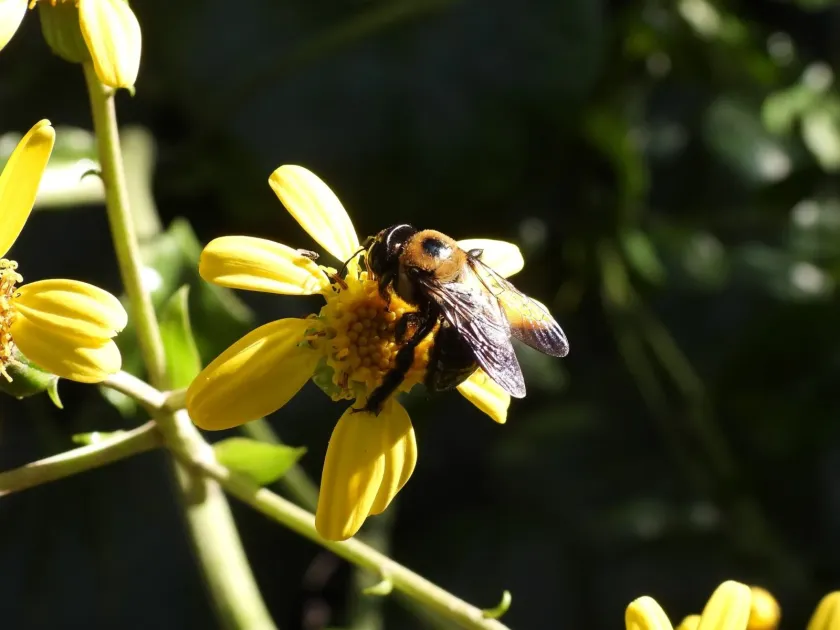
The Eastern carpenter bee (Xylocopa virginica) is a solitary, large-bodied insect belonging to the family Apidae. They are frequently mistaken for bumblebees but can be distinguished by their shiny, hairless abdomen.
These bees grow to about 20–25 mm in length. Their bodies are robust and often display a metallic sheen. They are equipped with powerful mandibles designed to carve tunnels into solid wood.
Unlike honeybees, they do not live in social colonies. Instead, each female functions independently, excavating a tunnel to lay her eggs and provide them with food supplies.
Their life cycle involves a complete metamorphosis. Adults overwinter in protected wood galleries, emerging in early spring to initiate the breeding process for the new season.
Males are harmless as they lack stingers, though they are notoriously territorial. They will often hover near entrances to nesting sites to deter intruders, creating a intimidating display.
What it damages
Carpenter bees do not feed on wood; they only use it as a nesting site. They prefer unpainted, weathered, or soft woods like pine, cedar, or redwood, which are common in garden structures.
They damage decks, pergolas, wooden fences, eaves, and outdoor furniture. In the orchard, they may tunnel into the dead branches of fruit trees, reducing the tree's overall stability.
The damage is caused by the construction of tunnels. A female bee bores an entrance hole and then turns to create a long gallery, which can extend several inches into the timber.
Inside the tunnels, they create individual cells for their offspring, separated by partitions made of wood pulp and saliva. This structure compromises the structural integrity of wooden beams.
Over time, these tunnels allow moisture to penetrate the wood, which invites secondary issues like fungal decay and rot, accelerating the degradation of the affected building materials.
When it appears
Adult carpenter bees become active early in the spring, typically when daytime temperatures consistently reach warm levels, signaling the end of their overwintering phase.
The peak period of activity occurs during the late spring and early summer, specifically May and June, which aligns with the mating and nest-building season.
Throughout the summer, bees continue to forage for pollen and nectar to stock their nesting cells. During this time, they are most visible as they fly back and forth to their nests.
The new generation of adult bees emerges in late summer or early autumn. They feed on nectar for several weeks before seeking out suitable spots to hibernate through the winter.
The duration of their activity is climate-dependent. In warmer regions, they may remain active for longer periods, potentially impacting multiple cycles of wood maintenance.
Signs of infestation
The primary sign of infestation is the presence of perfectly circular entrance holes, approximately 10–12 mm in diameter, found on wooden surfaces.
Small piles of sawdust (frass) beneath the entry points are a telltale sign that a carpenter bee is currently excavating a tunnel inside the wood.
- Stains or streaks of waste material below the entrance holes.
- A distinct buzzing or gnawing sound audible from inside the wooden members.
- Increased bird activity, as woodpeckers often peck at the wood to reach the larvae inside.
Over several years, the accumulation of multiple nests can result in significant structural weakness, often unnoticed until a board breaks or requires replacement.
Inspect areas like the underside of porch railings, window sills, fascia boards, and outdoor structures to identify early signs of nesting behavior.
Control measures
The most effective preventative measure is to keep all exposed wood painted, stained, or sealed, as carpenter bees generally avoid treated or finished surfaces.
For existing infestations, inject an approved insecticide dust or aerosol into the nesting holes to kill the larvae and the adult bee residing inside.
After treatment, it is critical to seal the holes with wooden dowels, putty, or exterior-grade caulk to prevent the bees from reusing the tunnel or moisture from entering.
Consider installing physical barriers like fine mesh or metal flashing on vulnerable areas if you live in an area with a high population of these bees.
In the garden, remove dead or rotting branches from trees and shrubs to eliminate natural nesting sites, which helps keep the population localized away from your structures.
Taxonomy
- Latin name
- Xylocopa virginica
- Order
- Hymenoptera
- Family
- Apidae
- EPPO code
- XYOAVI
Discussion
No discussions yet — be the first.