
Hairy-footed flower bee
Anthophora plumipes
Description
How to identify
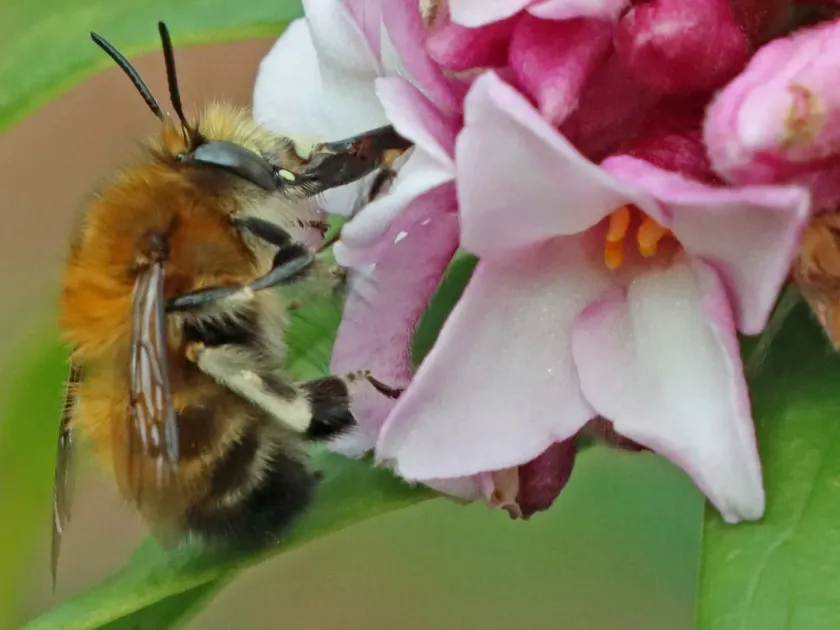
The hairy-footed flower bee (Anthophora plumipes) is a species of solitary bee in the Apidae family. They are frequently mistaken for bumblebees due to their dense, fuzzy appearance.
The males are particularly distinct because of the long, pale hairs on their middle legs, which look like brushes. Females are generally darker, often appearing almost black, with a robust body shape.
Although solitary, these bees often nest in aggregations, creating small tunnels in dry, hard-packed soil or sometimes in soft mortar between bricks in old walls.
They are among the fastest-flying bees in the garden, exhibiting a very agile flight pattern and a high-pitched buzz that sets them apart from the heavier, slower bumblebees.
They have an exceptionally long tongue, allowing them to extract nectar from deep-throated flowers such as lungwort, primroses, and dead-nettles.
What it damages
The hairy-footed flower bee is not a pest. They do not feed on plant foliage, stems, or fruits, and they do not transmit plant diseases, making them harmless to agricultural produce.
These bees are highly efficient pollinators. By moving between flowers to collect nectar and pollen, they play a crucial role in the fertilization of early-flowering fruit trees and berry bushes.
Some gardeners worry about their nesting habits, but the actual damage to buildings is negligible and limited to very soft, degraded mortar or exposed soil surfaces.
The ecological value of this bee far outweighs any minor inconvenience caused by their nest sites, as they significantly contribute to increased crop yields in home orchards.
Classifying this species as a pest is incorrect; they should be protected and encouraged as a natural ally for any gardener or farmer.
When it appears
Adult hairy-footed flower bees emerge in early spring, typically between March and May, perfectly timing their appearance with the bloom of early spring flowers.
They are active throughout the pollination season of orchard fruits, ensuring that flowers are fertilized during the critical early part of the growth cycle.
The adult life span is relatively short, and they die off after the mating and nesting season ends in early summer.
The larvae hatch in the underground cells prepared by the female, where they consume the stored pollen and nectar throughout the warm summer months.
By late summer, the larvae have developed into pupae or adults, entering a state of dormancy to survive the winter within their protective underground nests.
Control measures
No control measures are needed for the hairy-footed flower bee. As a vital pollinator, they are an asset to the environment and should not be treated as targets for extermination.
The use of insecticides should be strictly avoided during the spring flowering season, as these chemicals are lethal to bees and will negatively impact the pollination of your crops.
If you wish to discourage them from nesting in specific areas, improve the soil or cover bare patches with mulch or vegetation to make the ground less attractive for tunnel excavation.
To protect building structures from nesting, ensure masonry is well-maintained and sealed with appropriate pointing or plaster, which prevents the bees from exploiting weak spots.
- Avoid all pesticide use during the spring blooming period.
- Plant a variety of early-flowering plants to support the bee population.
- Use physical barriers like mulch to discourage soil nesting in undesired areas.
Taxonomy
- Latin name
- Anthophora plumipes
- Order
- Hymenoptera
- Family
- Apidae
- EPPO code
- ANHPPL
Discussion
No discussions yet — be the first.