
Giant honey bee
Apis dorsata
Description
How to identify
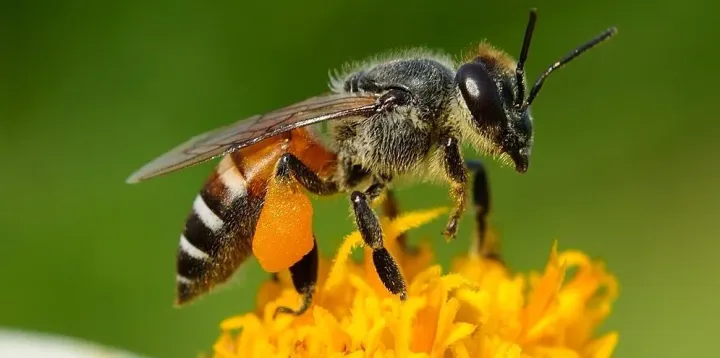
The giant honey bee, scientifically known as Apis dorsata, is one of the largest honey bee species in the world. Workers typically measure between 17 and 20 mm in length and exhibit a dark, robust appearance with significant hair density. Unlike managed species, they do not nest in enclosed hives, opting instead for large, open-air nests.
Nests of Apis dorsata are built as massive, single-comb structures suspended from tall tree branches or cliff faces. A single colony can contain tens of thousands of individuals. The bees form a thick, protective curtain over the surface of the comb, shielding the developing brood and honey stores from environmental threats and predators.
These bees are known for their migratory behavior, moving across vast distances in Southeast Asia in response to regional flowering cycles. This adaptation allows them to exploit abundant food sources but makes it impossible to maintain them in standard apiaries, as they prefer to return to specific, preferred nesting sites year after year.
Systematically, the species belongs to the Apidae family. They are highly defensive, which is a necessary evolutionary strategy for an open-nesting insect. Their role in the ecosystem is primarily centered on broad-spectrum pollination, which is essential for the reproduction of countless tropical plant species.
While they are not traditional agricultural pests, their interaction with human activities often leads to conflict. The primary issue is their aggressive defensive nature, which poses significant safety challenges for farmers and plantation workers in regions where these bees are endemic.
What it damages
The giant honey bee is not a pest that consumes or damages crops. On the contrary, Apis dorsata is a vital pollinator. Its presence in agricultural landscapes significantly boosts yields for various crops, including fruits, nuts, and oil-bearing plants, by facilitating efficient cross-pollination across large areas.
The conflict in agricultural settings usually stems from resource competition. In areas where commercial beekeeping is practiced, high populations of giant honey bees can dominate floral sources, limiting the forage available to domesticated colonies, which may lead to reduced honey yields and weaker domestic bee populations.
Operational damage is a more frequent concern for estate managers. When a colony establishes a nest on high-value fruit trees or within harvesting zones, human activity becomes hazardous. The defensive behavior of Apis dorsata can halt harvesting operations for weeks, leading to significant delays and potential crop losses.
Water access in arid or managed agricultural regions can also become a focal point of conflict. Because giant honey bees require water for nest thermoregulation, they can congregate in large numbers around irrigation valves or technical water storage, hindering maintenance and operational staff.
Indirect negative impacts occur during pesticide application. Because of their ecological importance, the death of these bees due to chemical exposure is highly damaging. However, their presence often complicates the timing of pest control measures, as standard spraying regimes are dangerous to these wild colonies.
Control measures
Management of Apis dorsata should focus on non-lethal, preventative measures. Given their critical role in biodiversity and forest health, extermination is generally discouraged and often prohibited. Instead, strategies should emphasize coexistence and site safety management.
To reduce nesting prevalence, plantation layout and maintenance are key. Regular pruning of large, horizontal tree branches in working areas makes the canopy less attractive for nest construction. Maintaining open spaces away from high-density harvesting zones helps separate human work activities from bee colonies.
When a nest is identified, the area should be clearly demarcated and excluded from normal work schedules. Avoiding any disturbance, such as loud machinery, smoke, or physical interference, is essential to prevent triggering an aggressive defensive reaction from the colony.
In scenarios where a colony absolutely must be moved, specialized relocation services should be engaged. Handling such large, wild colonies requires extensive experience, and attempting to move or disturb them without professional knowledge puts both the worker and the colony at significant risk.
- Implement pruning cycles to minimize potential nesting sites in crops.
- Establish safety buffer zones around known colony locations.
- Use protective gear when working near nesting areas in tropical plantations.
Taxonomy
- Latin name
- Apis dorsata
- Order
- Hymenoptera
- Family
- Apidae
- EPPO code
- APISDO
Discussion
No discussions yet — be the first.